
COLLABORATIVE PALLETIZING SYSTEM
Collaborative Palletizer for Flexible Production Automation
ATOP collaborative palletizers provide compact and flexible automation for repetitive palletizing tasks. Designed for small-batch production, multiple product formats and changing production requirements.
Small footprint for limited production space
Flexible for different products and formats
Stable palletizing with consistent performance
Connect with existing production lines
KEY APPLICATIONS
Flexible Palletizing for Different Products
Collaborative palletizers are designed for flexible production environments where product types, packaging formats and palletizing requirements may change frequently.
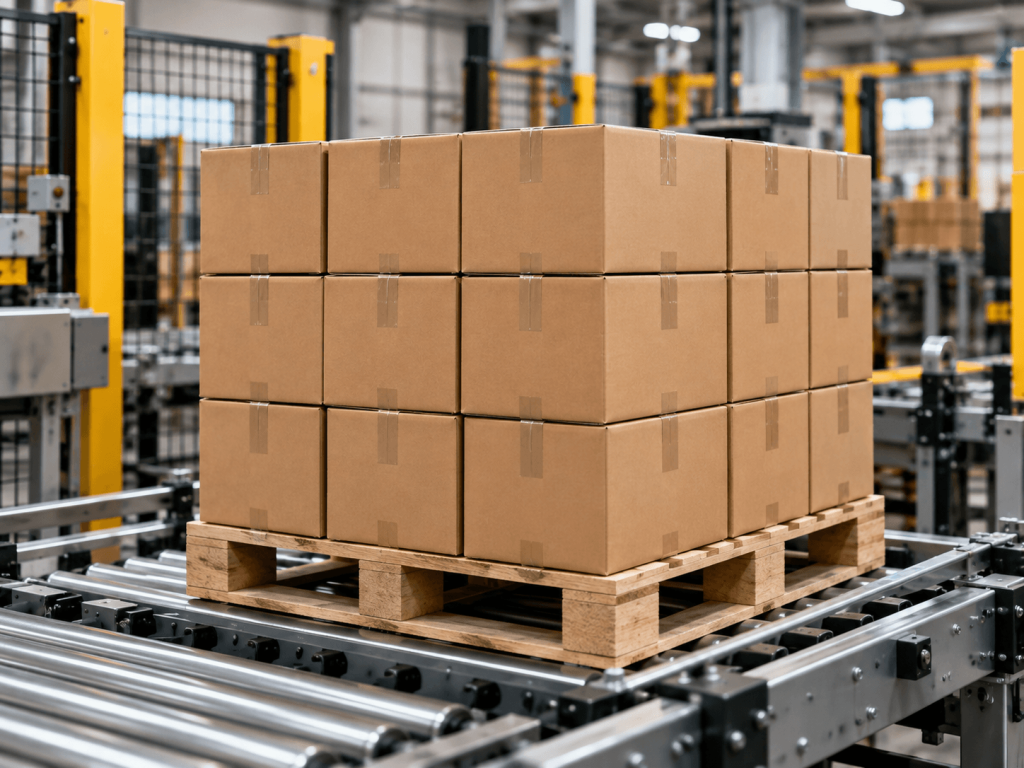
Cartons & Cases
Flexible handling for boxed products in different sizes and formats.
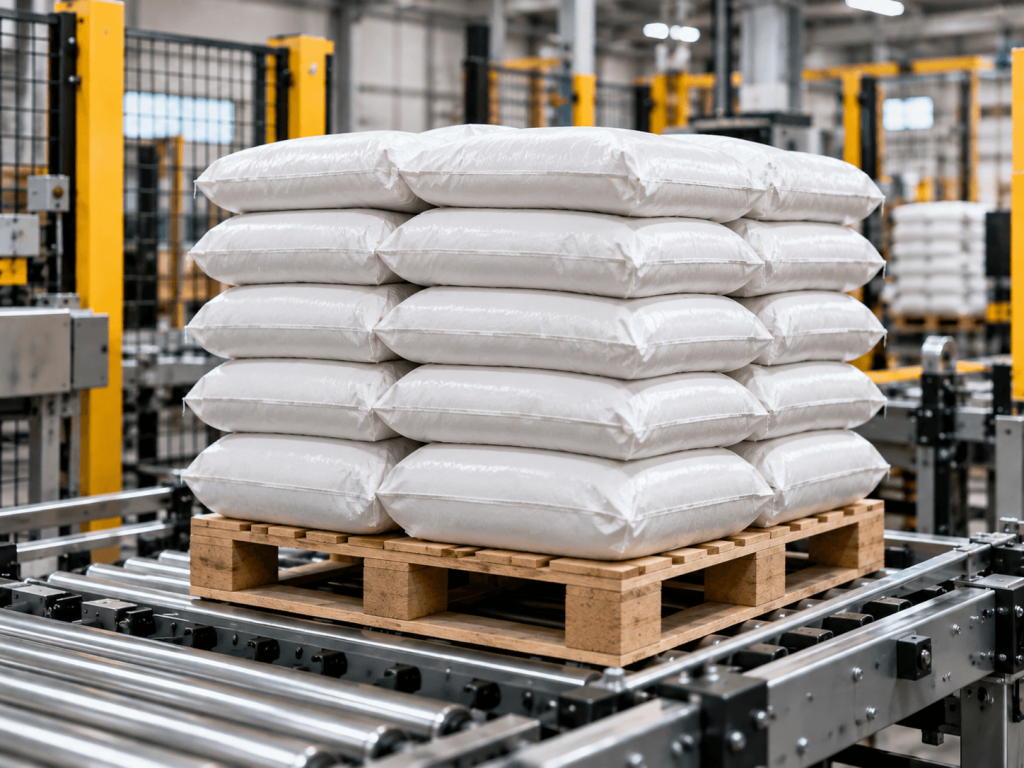
Bags & Sacks
Compact automation for bagged products requiring consistent pallet stacking.
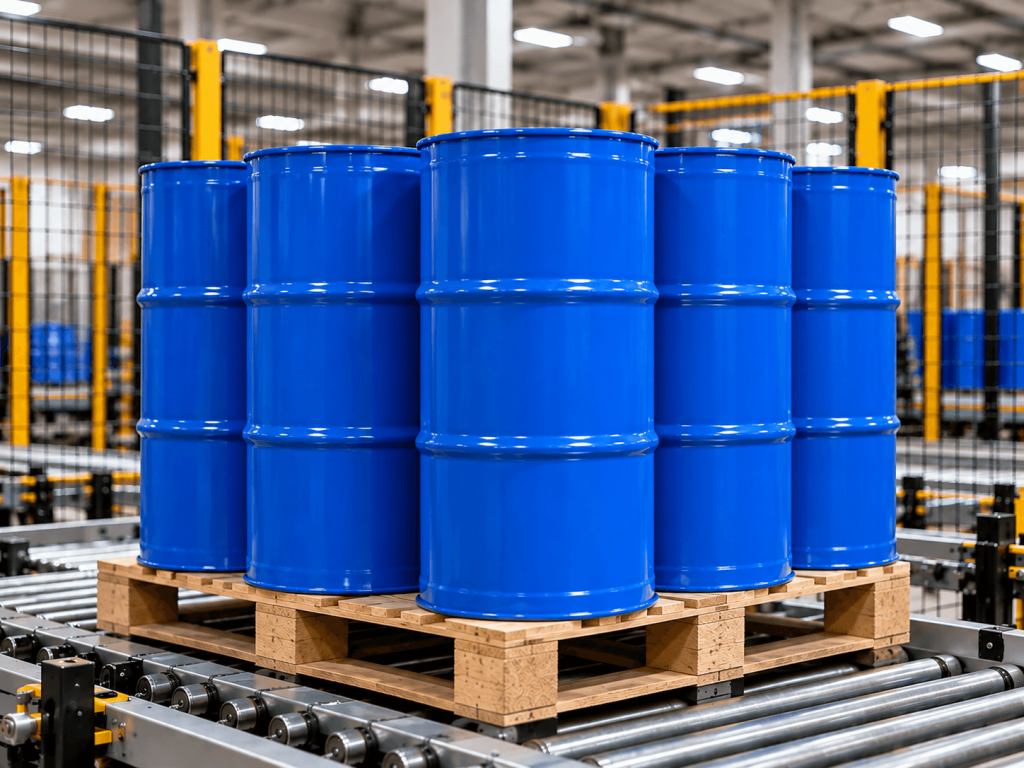
Pails & Containers
Reliable palletizing for containers with different shapes and handling requirements.
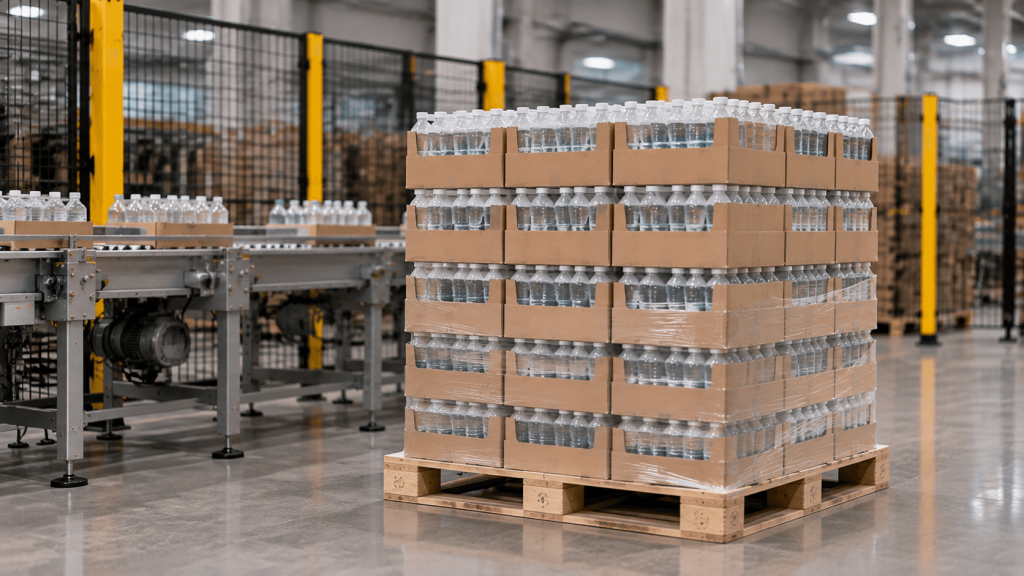
Food & Beverage
Flexible solutions for packaged food and beverage production lines.
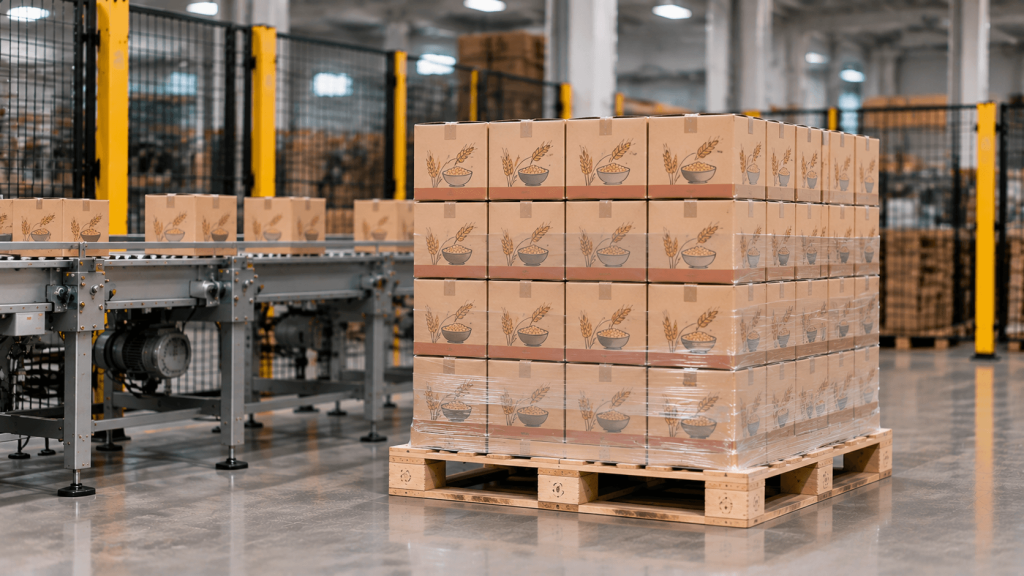
Consumer Products
Suitable for changing product formats and multi-SKU production.
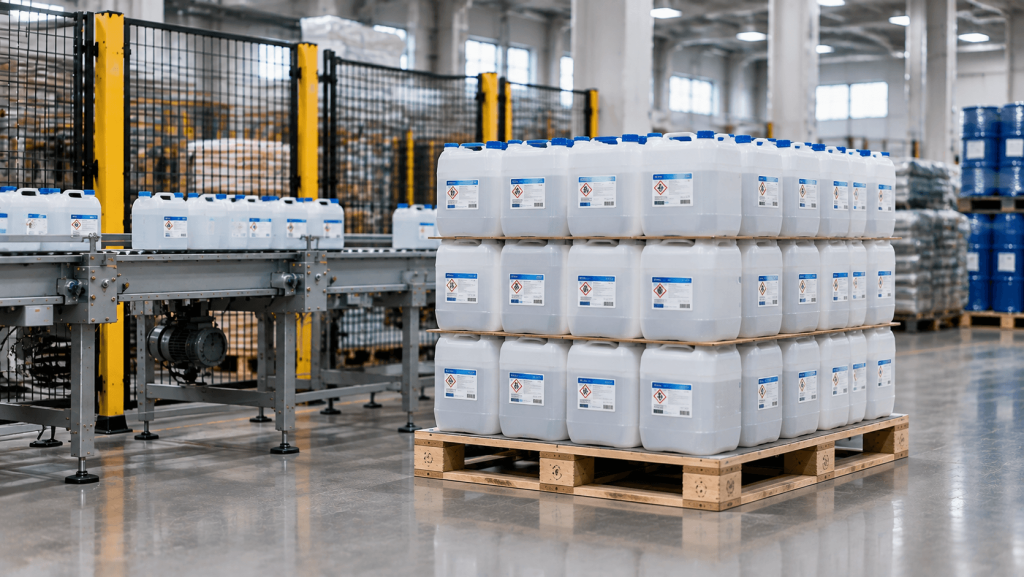
Industrial Products
Automation solutions for repetitive palletizing tasks in industrial applications.
HOW IT WORKS
From Infeed to Finished Pallet
ATOP collaborative palletizing systems combine product conveying, robotic handling and programmed pallet patterns into a flexible automation process.
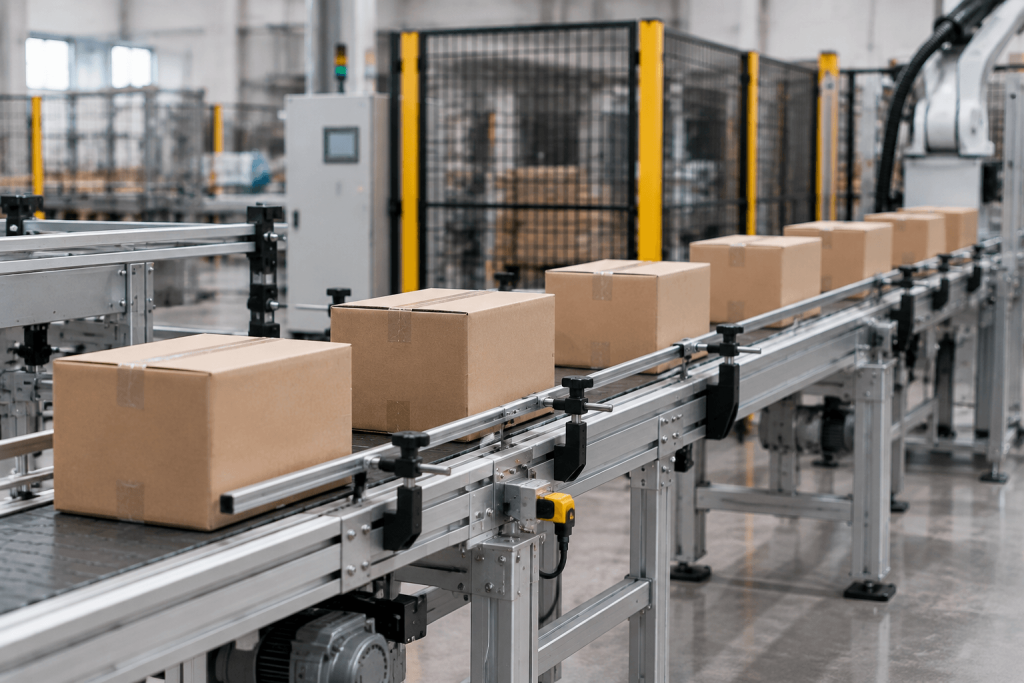
01
Product Infeed
Products enter the system through an automated conveyor line.
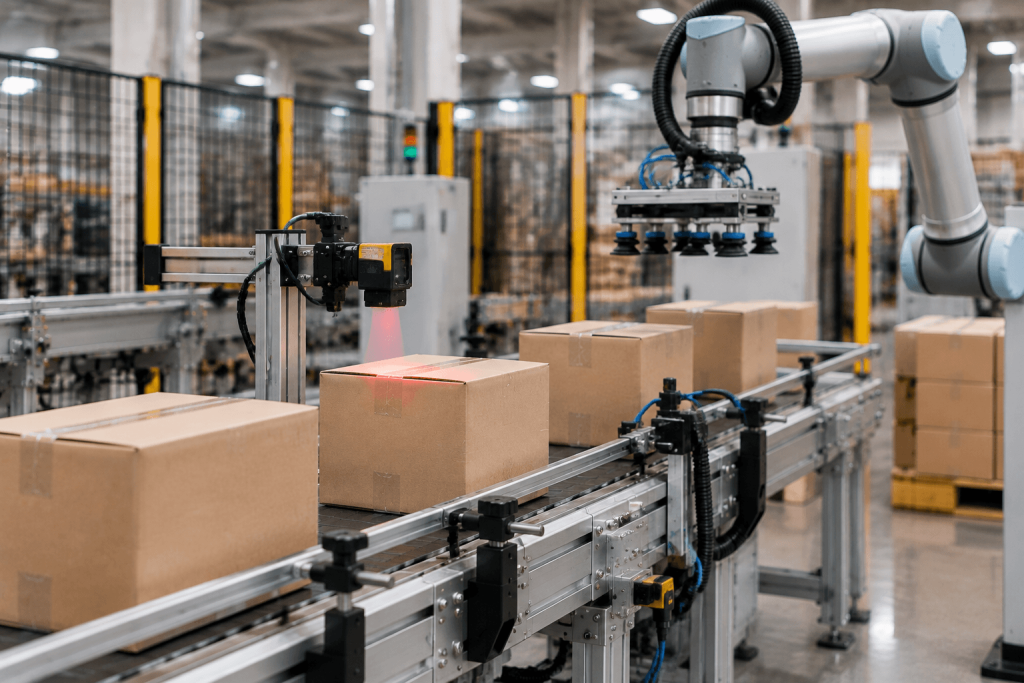
02
Product Detection
The system identifies product position and prepares the handling sequence.
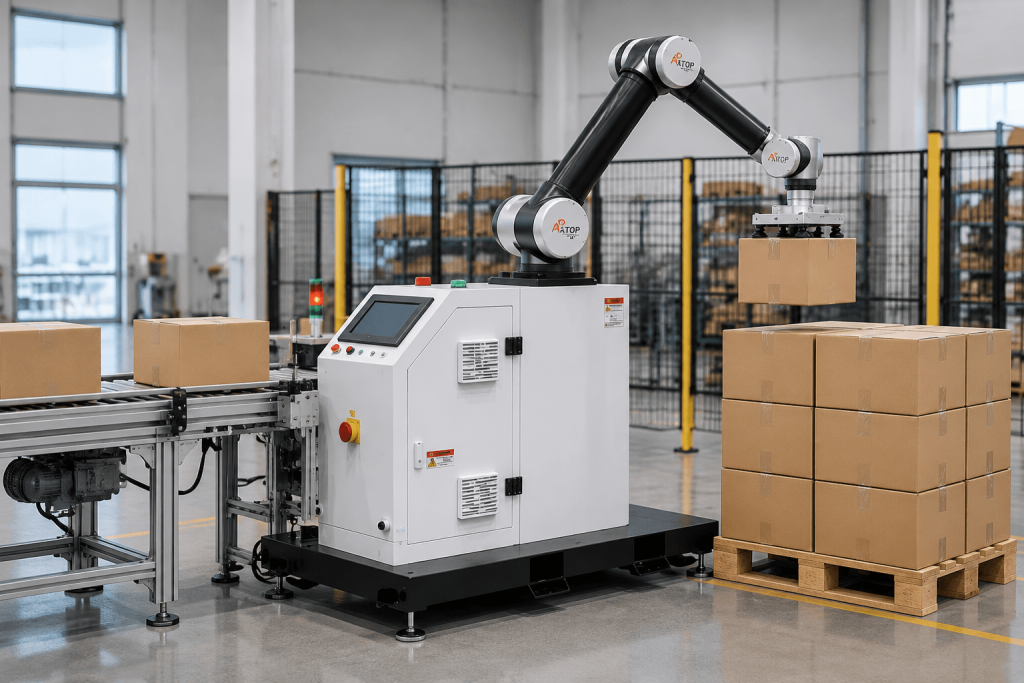
03
Robotic Picking
The cobot picks products using application-specific tooling.
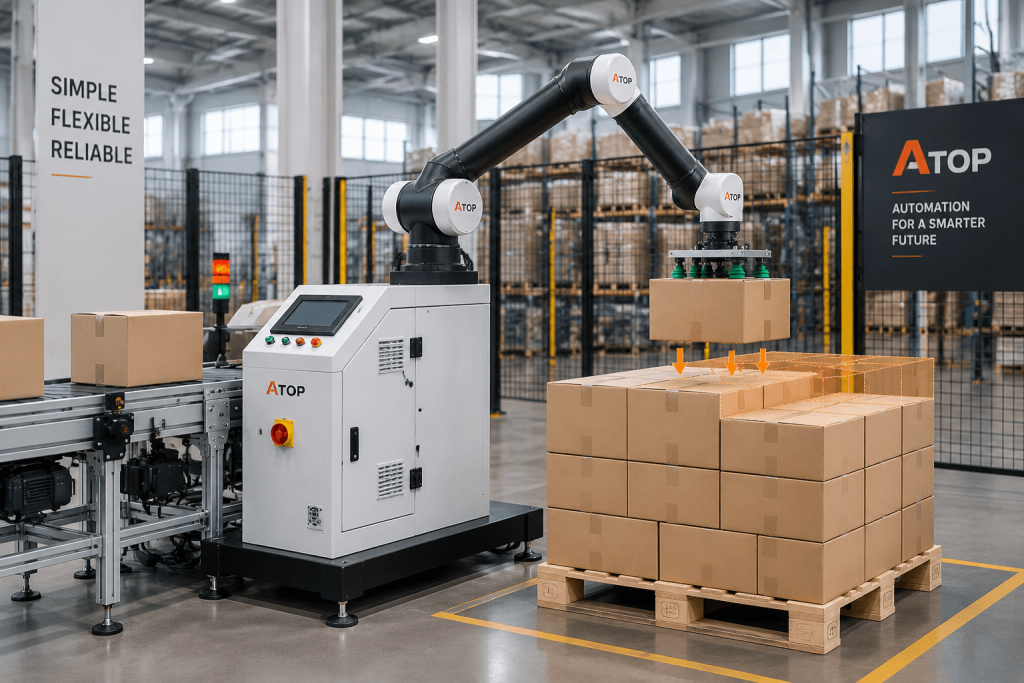
04
Layer Formation
Products are placed according to programmed pallet patterns.
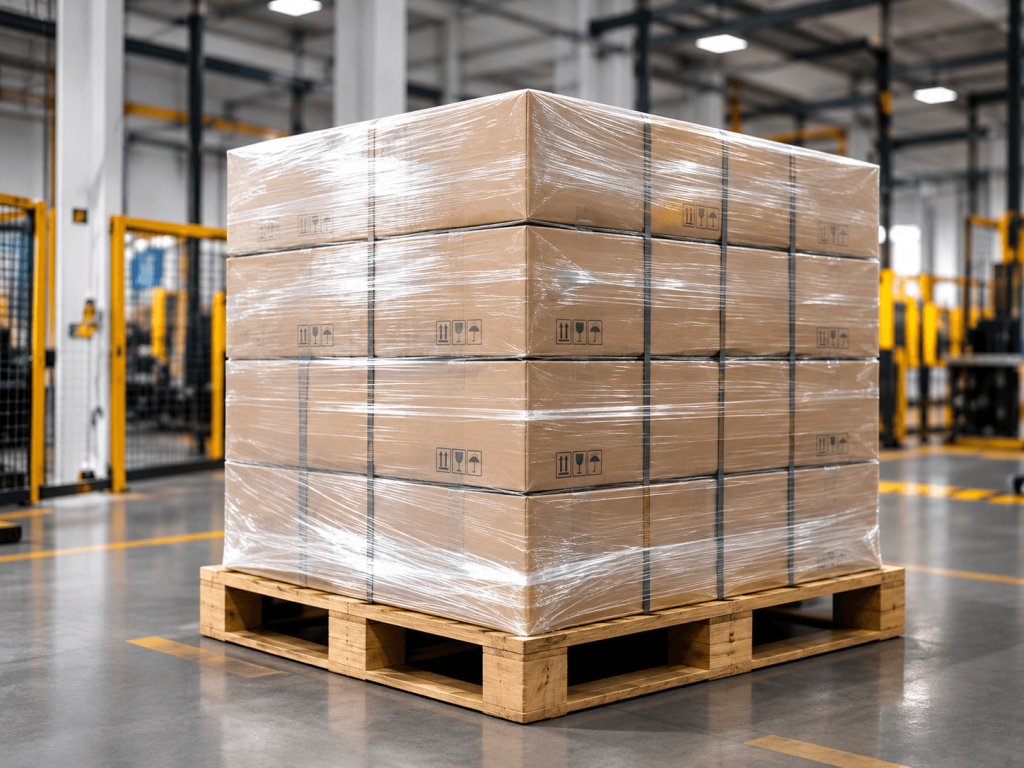
05
Finished Pallet
Completed pallets move to wrapping or downstream handling.
WHY COLLABORATIVE PALLETIZING
Flexible Palletizing Without a Large Automation Footprint
Collaborative palletizers offer a compact approach to automating repetitive palletizing tasks, especially where production space, product variety and changing requirements make a large fixed palletizing cell less practical.
ATOP systems combine the collaborative robot, control cabinet and palletizing functions into a compact platform that can be configured around the product, pallet pattern and production-line interface.
Best suited to applications where flexibility, compact installation and repetitive palletizing automation are more important than simply maximizing line speed.
Compact Footprint
An integrated machine layout helps reduce the space required for automated palletizing..
Flexible Product Handling
Product recipes and pallet patterns can be configured around different production requirements.
Programmable Pallet Patterns
Stacking sequences can be programmed according to product dimensions, pallet size and required arrangement.
Production-Line Integration
The palletizer can be connected with upstream conveyors and configured for the required downstream pallet handling process.
Details
Common questions
How is this different from a full robotic palletizer?
Collaborative cells are sized and priced for lower volumes and smaller footprints. Payload, speed and safety fencing requirements are lower than a full industrial robotic cell — exact specifications are confirmed based on your product and output needs.
Is this a good fit for a first automation project?
Yes — this is typically the lower-risk entry point for operations that haven’t automated palletizing before, with a smaller footprint and lower upfront cost than a full robotic or gantry system.
How is installation handled?
Installation is guided through video walkthroughs and live video commissioning support, with on-site engineer deployment available where required.
BEST-FIT APPLICATIONS
BEST-FIT APPLICATIONS
Collaborative palletizing is especially useful when manufacturers need flexible automation without building a large fixed palletizing cell. The right solution depends on product type, production rate, pallet pattern, available space and how often production requirements change.
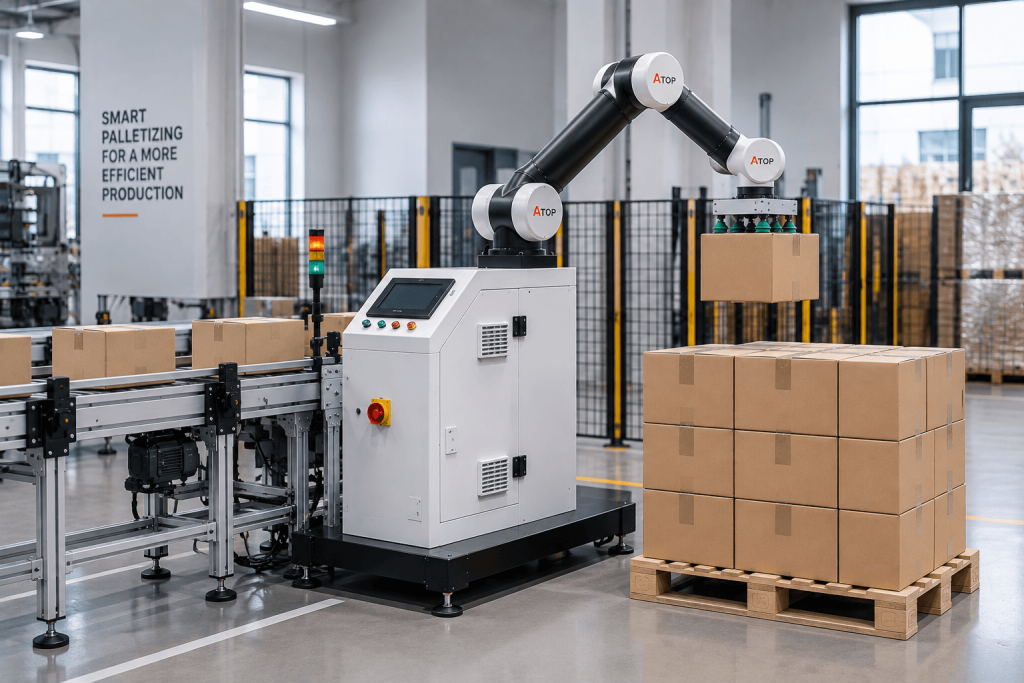
Smaller Production Lines
A compact palletizing system can be considered where floor space is limited and a large conventional palletizing cell is not practical.
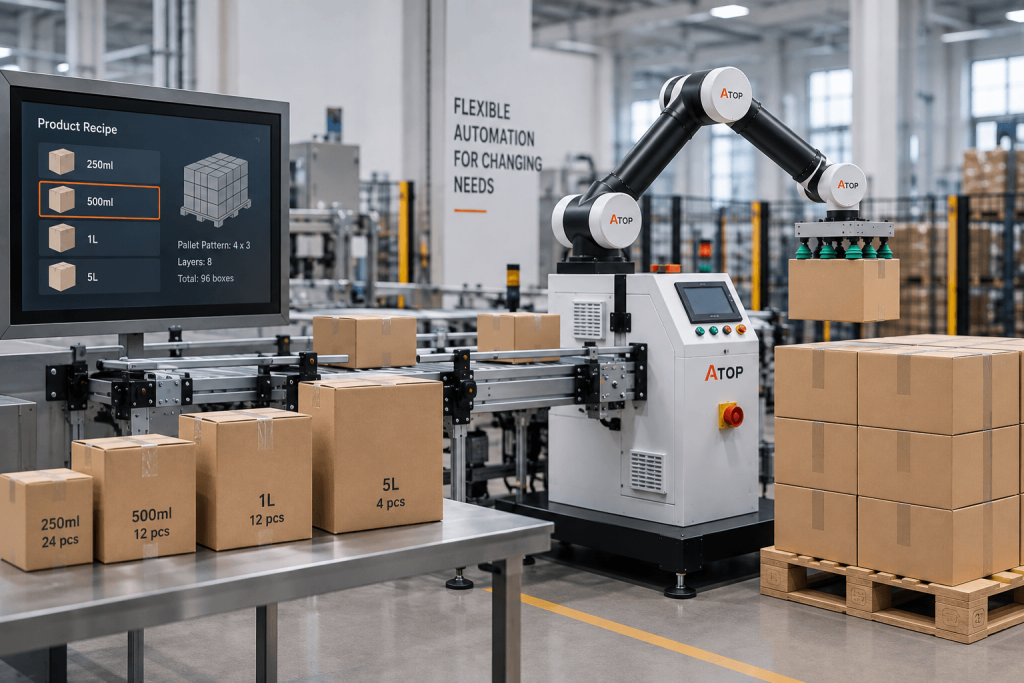
Multi-SKU & Product Changeovers
Programmable product recipes and pallet patterns make collaborative palletizing suitable for production environments where product formats change over time.
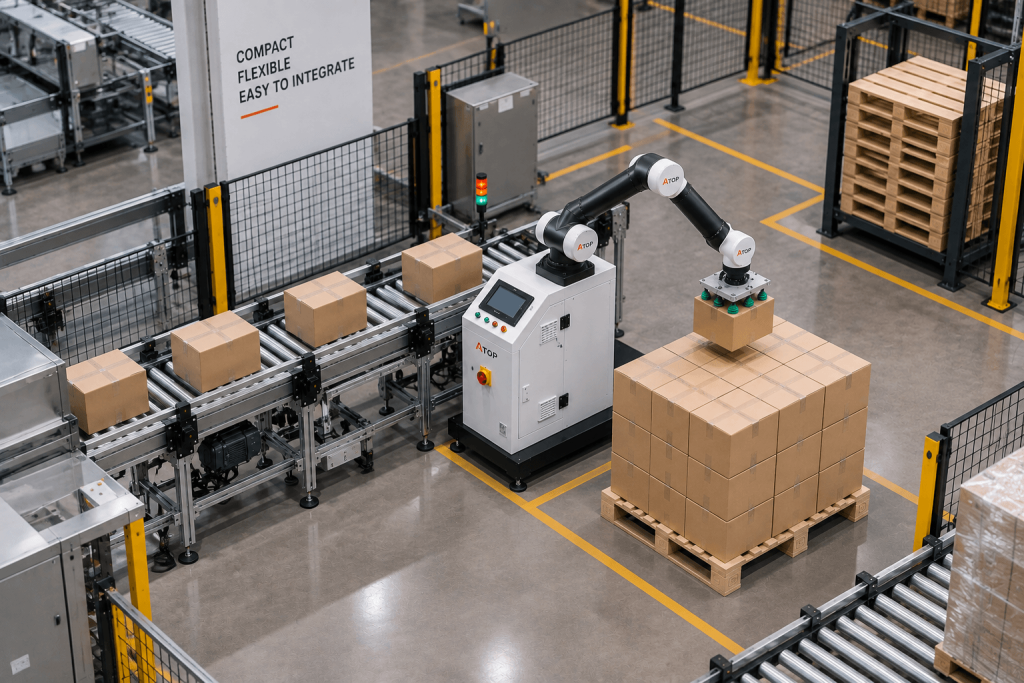
Space-Constrained Layouts
The integrated palletizer can be configured around existing conveyors, pallet positions and available production-floor space.
ENGINEERED FOR YOUR END-OF-LINE
From Collaborative Palletizing to a Complete Material Flow
The collaborative palletizer can be connected with product infeed, pallet handling and downstream equipment to create a coordinated end-of-line process around the actual production layout.
ATOP configures the palletizing station around product flow, pallet positions and downstream requirements, while additional equipment can be integrated according to the final project scope.
The palletizer is the core. The surrounding material flow turns it into a complete automation system.
Product Infeed
Upstream conveyors deliver products to the palletizing station in a controlled and repeatable flow.
Pallet Handling
Pallet positioning and full-pallet handling can be configured according to the required production layout.
Stretch Wrapping
Completed pallets can continue to automatic stretch wrapping when the downstream process requires load securing.
Controls & Line Coordination
Sensors, control logic and equipment interfaces coordinate product flow between the palletizing station and connected equipment.
FREQUENTLY ASKED QUESTIONS
Collaborative Palletizer FAQs
What is a collaborative palletizer?
A collaborative palletizer is an automated palletizing system that uses a collaborative robot to pick products from an infeed position and place them onto a pallet according to a programmed stacking pattern. It is commonly considered for applications where compact installation, product flexibility and repetitive palletizing automation are important.
How does a collaborative palletizer work?
Products enter the palletizing station through an infeed conveyor or defined pickup position. The collaborative robot picks each product with the configured end-of-arm tooling and places it onto the pallet according to the programmed pallet pattern. The sequence continues until the required pallet load is completed.
Can one collaborative palletizer handle different product sizes?
Yes, different product formats can be configured through product recipes and palletizing programs when they are compatible with the robot, gripper and system design. A change in product size may require a different pallet pattern or handling configuration depending on the application.
Collaborative palletizer or industrial robot palletizer — which should I choose?
The choice depends on the application. Collaborative palletizing is often considered for compact layouts, flexible production and moderate palletizing requirements, while industrial robotic palletizing may be better suited to applications requiring different payloads, reach, cycle rates or multi-line configurations. Product data and production requirements should be evaluated before selecting the system architecture.
What products can a collaborative palletizer handle?
A collaborative palletizer can be configured for cartons, cases, bags, pails, containers and other packaged products. Suitability depends on product dimensions, weight, packaging stability, required output and the type of gripper used for the application.
How much space does a collaborative palletizer require?
The required footprint depends on the robot reach, product infeed direction, pallet position, guarding requirements and surrounding equipment. Collaborative palletizing systems are often considered where a compact automation layout is important, but the final footprint should be confirmed from the actual production-line layout.
Can a collaborative palletizer connect to an existing production line?
Yes. The palletizing station can be configured to receive products from an existing conveyor or packaging line. The final interface depends on product flow, conveyor height, pickup position, pallet location and the control signals required between connected equipment.
What information is needed to select a collaborative palletizer?
To evaluate the application, we normally need the product type, dimensions and weight, required production rate, pallet size, stacking pattern, target pallet height and available production-line layout. Photos or videos of the current production line are also helpful for evaluating product infeed and pallet positioning.
PLANNING A COLLABORATIVE PALLETIZING PROJECT?
Tell Us About Your Product & Production Line
Share your product details, required output, pallet configuration and available line layout. ATOP will evaluate the application and recommend a suitable collaborative palletizing configuration for your production requirements.