
COMPLETE END-OF-LINE AUTOMATION
Complete End-of-Line Automation for Integrated Production Flow
From Packaging Output to Finished Pallet
We design and integrate complete end-of-line automation solutions around your existing production process, connecting product handling, secondary packaging, conveying, palletizing, wrapping and downstream pallet flow into one coordinated system.
The automation scope can start from a single process or extend across multiple downstream operations, depending on your current line and future goals.
Single Process to Complete Line
Packaging · Palletizing · Pallet Flow
New Lines & Automation Upgrades
01 FLEXIBLE AUTOMATION SCOPE
Where Should Your End-of-Line Automation Begin?
Every production line starts from a different point. Some facilities already have secondary packaging equipment, while others need several downstream processes to be connected into one automated flow.
Your end-of-line project can begin where your existing process ends and extend only as far as your production and logistics requirements demand.
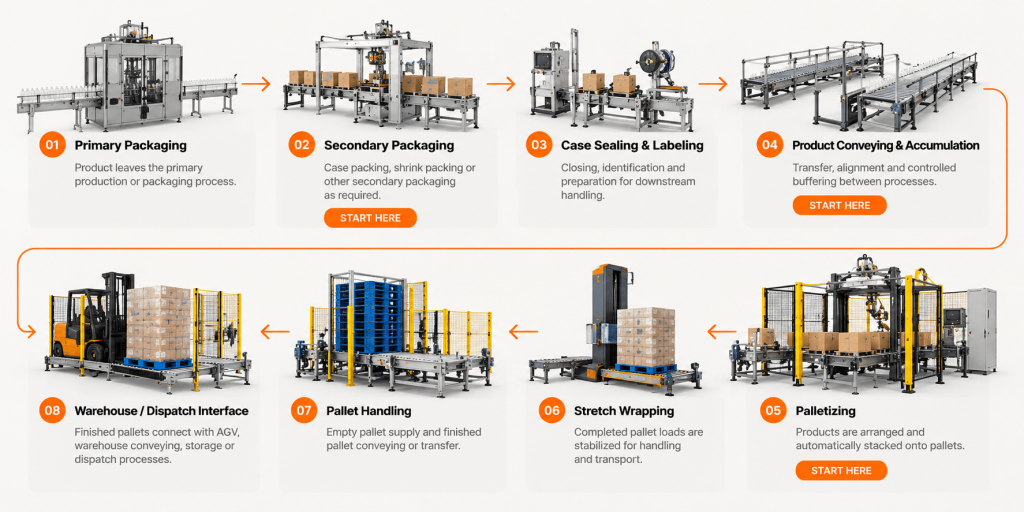
Does complete end-of-line automation require replacing my existing equipment?
No. A complete end-of-line solution can be designed around equipment that is already operating effectively. The automation scope can begin from the existing line discharge point and integrate only the additional conveying, palletizing, pallet handling, wrapping or other downstream processes required for the project.
AUTOMATION SOLUTION OPTIONS
Define the Right Automation Scope for Your Line
Not every project requires a complete downstream line from the beginning. The right automation scope depends on what is already installed, which processes still rely on manual handling and how far you want the finished product to move automatically.
Start with the process you need today, while keeping future integration in mind.
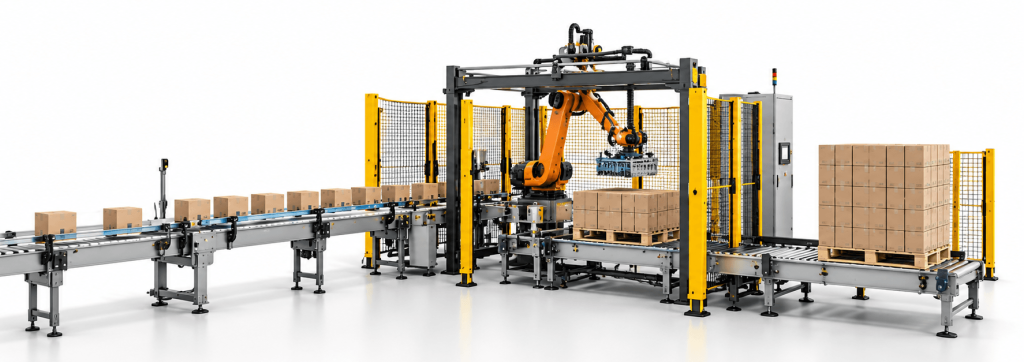
A · FOCUSED AUTOMATIONA
Palletizing Cell
Add automatic palletizing to an existing packaging or production line without unnecessarily changing upstream equipment that already works.
Typical Scope
Existing Product Infeed
→ Product Alignment / Grouping
→ Automatic Palletizing
→ Finished Pallet Outfeed
Best evaluated when:
- Existing packaging equipment remains in use
- Manual palletizing is the main bottleneck
- A focused automation upgrade is preferred
- Future downstream expansion may be required
Typical starting point: Existing conveyor discharge
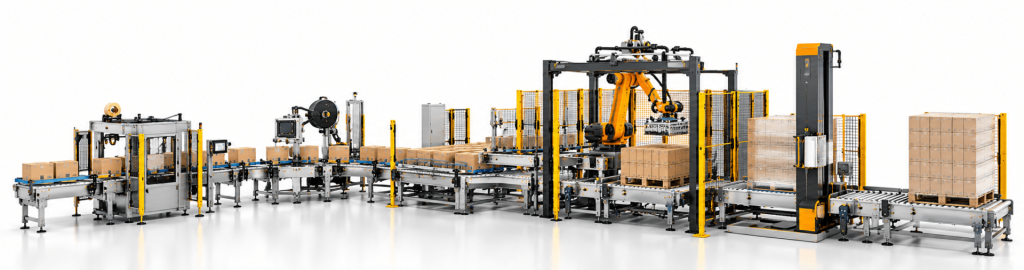
B · INTEGRATED AUTOMATION
Integrated End-of-Line
Connect the output of existing packaging equipment with product handling, palletizing and finished pallet processes as one coordinated downstream system.
Typical Scope
Packaging Output
→ Product Conveying
→ Grouping / Layer Formation
→ Palletizing
→ Stretch Wrapping
→ Finished Pallet Transfer
Best evaluated when:
- Several downstream processes need automation
- Palletizing and pallet flow need to operate together
- Manual handling exists between separate machines
- A coordinated end-of-line system is required
Typical starting point: Packaging machine discharge
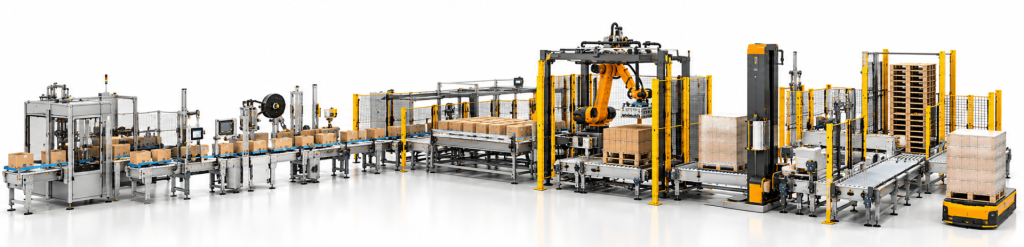
C · COMPLETE INTEGRATION
Complete Downstream Integration
Integrate multiple downstream processes from secondary packaging through pallet handling and the interface with warehouse or logistics automation.
Typical Scope
Secondary Packaging
→ Sealing / Labeling
→ Product Handling
→ Palletizing
→ Stretch Wrapping
→ Pallet Handling
→ Warehouse / AGV Interface
Best evaluated when:
- A new line or major automation upgrade is planned
- Multiple equipment processes must be coordinated
- Manual transfer between processes should be reduced
- Future warehouse or logistics automation is considered
Typical starting point: Secondary packaging
Which automation scope is right for your production line?
The right scope depends on your existing equipment, current manual processes, production requirements and future automation plans. A complete solution does not necessarily mean replacing the entire line—it means connecting the processes that need to work together.
The objective is the right level of integration, not the largest number of machines.
WHAT ATOP BUILDS & INTEGRATES
One Integrated Solution, Clear Equipment Responsibility
A complete end-of-line project may involve equipment from different process stages. ATOP focuses on palletizing, material handling and downstream automation, while integrating additional packaging and logistics equipment when required by the project.
The objective is not to place individual machines together, but to make the complete production flow work as one coordinated system.
ATOP CORE AUTOMATION
Palletizing
Depalletizing
Product Conveying & Handling
Pallet Handling
Stretch Wrapping Integration
Controls & System Coordination
INTEGRATED PACKAGING EQUIPMENT
Case Packing
Case Sealing
Labeling
Inspection
Secondary Packaging
Downstream Logistics Interface
Finished Pallet Transfer
AGV / AMR Interface
Warehouse Conveyor Interface
Storage Interface
Dispatch / Loading Interface
SYSTEM INTEGRATION
One Production Flow · Coordinated Equipment · Defined Interfaces
Layout planning, equipment interfaces, product flow, pallet flow and control coordination are considered together according to the project scope.
What does “integrated” mean in an end-of-line automation project?
Integration means defining how equipment exchanges products, pallets and control signals throughout the production flow. This includes mechanical connections, conveyor interfaces, operating sequences, sensors, control communication and downstream transfer conditions.
The equipment does not need to come from one manufacturer to operate as one coordinated system.
NEW LINE OR EXISTING-LINE UPGRADE
New Production Line or Existing-Line Upgrade?
End-of-line automation can be planned as part of a new production line or integrated into an existing facility. The engineering priorities are different: a new line provides greater freedom for layout and system planning, while an upgrade must work around existing equipment, space and production conditions.
The objective is to automate what is needed without unnecessarily replacing equipment that already works.
01 NEW PRODUCTION LINE
Design the End-of-Line Flow from the Beginning
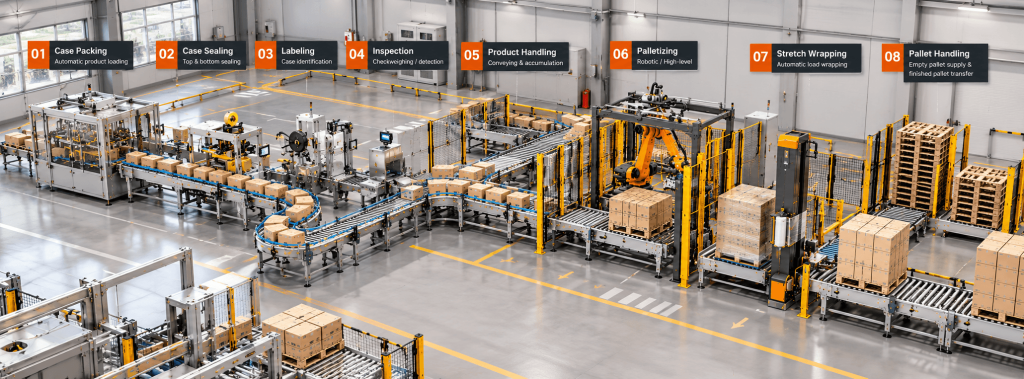
What We Evaluate
- Production Requirements
Product format, output and operating conditions - Equipment Sequence
How each downstream process should connect - Line Layout
Equipment position, conveyor routing and access - Product & Pallet Flow
Movement of products, empty pallets and finished loads - Control Architecture
Operating sequence and communication between processes - Future Expansion
Space and interfaces for possible future automation
Best suited for: New factories, new production lines or major production expansions.
02 EXISTING-LINE UPGRADE
Add Automation Around What Already Works
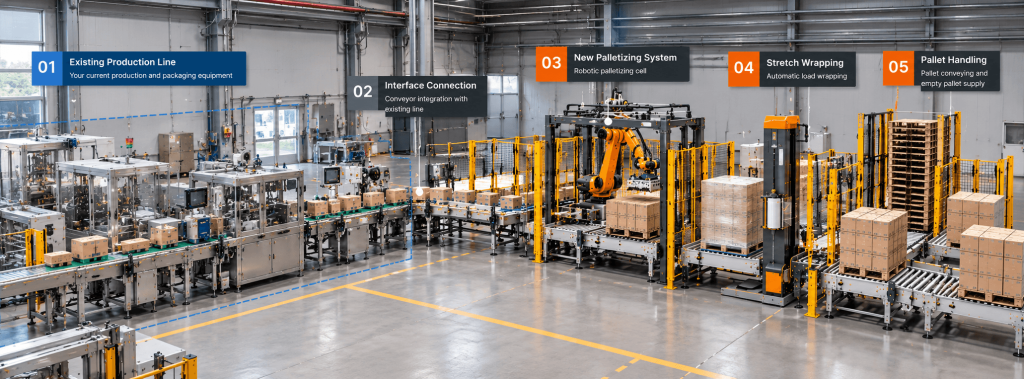
What We Evaluate
- Existing Discharge Point
Where products currently leave the upstream process - Conveyor & Product Interface
Conveyor height, direction, speed and product condition - Available Floor Space
Existing equipment, columns, aisles and maintenance access - Existing Controls
Signals and communication required between old and new equipment - Installation & Downtime
How the upgrade can be installed around production requirements - Future Integration
Whether additional wrapping, pallet handling or logistics automation may be added later
Best suited for: Existing factories replacing manual handling or extending current automation.
SYSTEM INTEGRATION
A Complete Line Depends on More Than Connecting Machines
Individual machines may each perform correctly, but the complete line can still experience accumulation, waiting or control conflicts if the interfaces between processes are not properly engineered.
A reliable end-of-line system requires product flow, mechanical connections, control logic and pallet handling to work together as one coordinated process.
Good integration happens between the machines.
01 · PRODUCT INTERFACE
How Does the Product Move Between Processes?
Product dimensions, orientation, spacing and transfer conditions must remain controlled as products move from one machine or conveyor to the next.
Product Orientation
Correct direction before the next process
Spacing & Timing
Controlled product spacing between equipment
Accumulation
Buffering short variations in production flow
Transfer Condition
Stable transition between conveyors and machines
ORIENTATION · SPACING · BUFFER · TRANSFER
02 · MECHANICAL INTERFACE
Can the Equipment Physically Work Together?
Equipment position, conveyor dimensions and physical connections should be coordinated before installation to avoid unnecessary modifications on site.
Conveyor Height
Matching product transfer levels
Equipment Position
Correct machine and conveyor arrangement
Access & Maintenance
Space for operation and service
Physical Connection
Defined mechanical transition between equipment
HEIGHT · POSITION · ACCESS · CONNECTION
03 · CONTROL INTERFACE
How Do Separate Machines Operate as One Line?
Connected equipment should exchange the required operating signals so the line can respond correctly to product flow, machine status, accumulation and faults.
Start / Stop Logic
Coordinated operating sequence
Machine Status
Running, ready, waiting and fault conditions
Sensors & Signals
Product and equipment condition feedback
PLC Communication
Required communication between connected systems
SIGNALS · PLC · SEQUENCE · STATUS
04 · PALLET & LOGISTICS INTERFACE
What Happens After the Products Are Palletized?
Palletizing is not the end of the material flow. Empty pallet supply, finished pallet transfer and downstream logistics should be considered as part of the overall system.
Empty Pallet Supply
Pallet delivery to the palletizing position
Finished Pallet Transfer
Removing completed loads without blocking production
Stretch Wrapping
Load stabilization before downstream handling
Warehouse / AGV Interface
Defined transfer point for subsequent logistics
PALLET SUPPLY · OUTFLOW · WRAPPING · LOGISTICS
WHY INTERFACES MATTER
A machine can be running correctly while the production line is still not running correctly.
Layout planning, equipment interfaces, product flow, pallet flow and control coordination are considered together according to the project scope.
What makes end-of-line integration different from buying individual machines?
Buying individual machines focuses on the function of each piece of equipment. End-of-line integration also considers how products, pallets and control signals move between those machines. Mechanical interfaces, operating sequences, accumulation, pallet supply and downstream transfer are therefore evaluated as part of one coordinated system.
PROJECT DELIVERY
From Engineering to a Running End-of-Line System
Once the automation scope and interfaces are defined, the project moves from engineering into manufacturing, testing and final implementation.
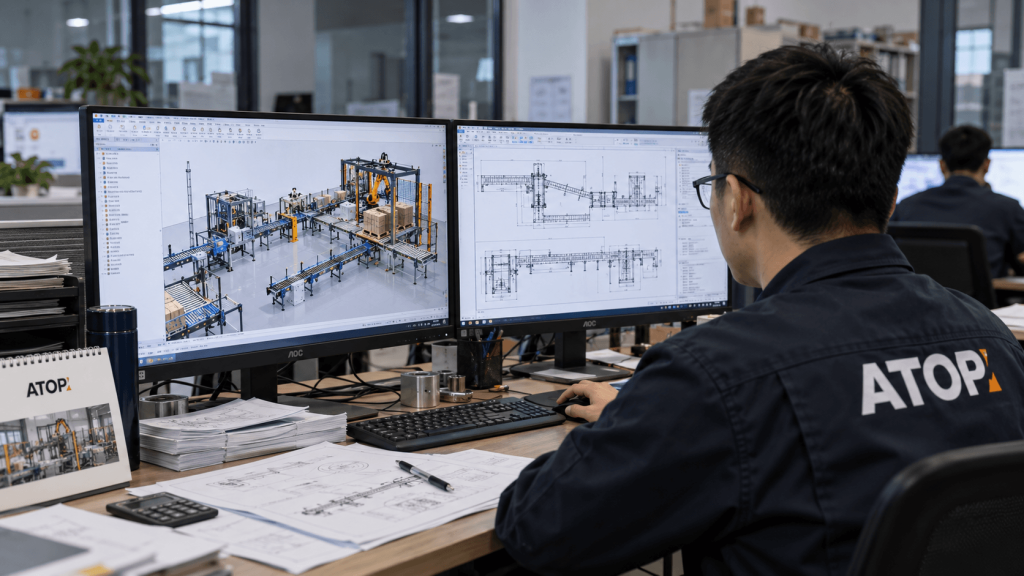
Engineering
Scope, layout and technical definition
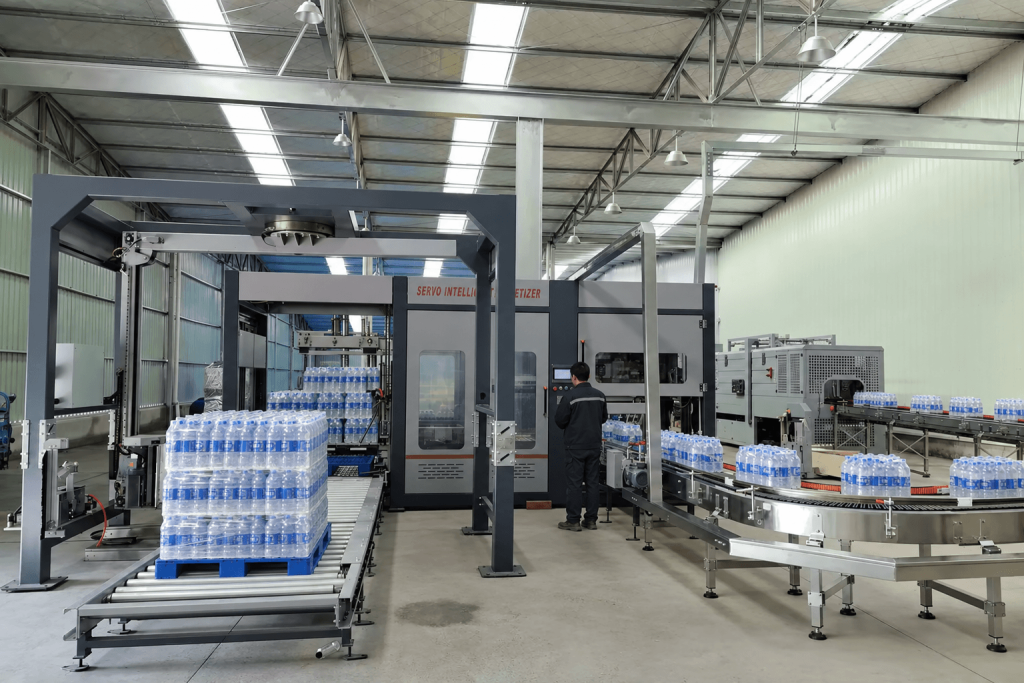
Manufacturing & Integration
Core equipment manufacturing and system coordination
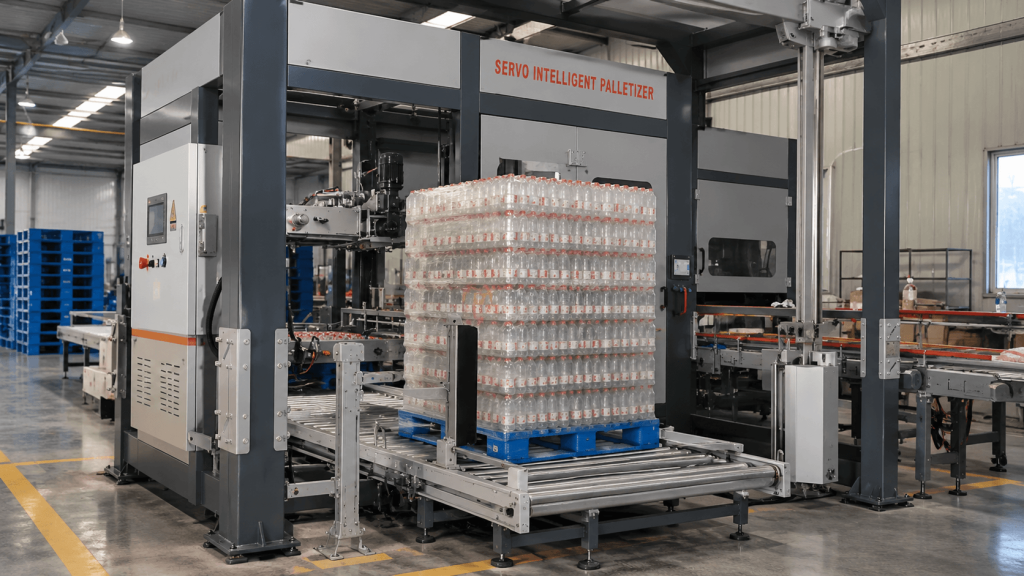
FAT
Functional and sequence verification before shipment
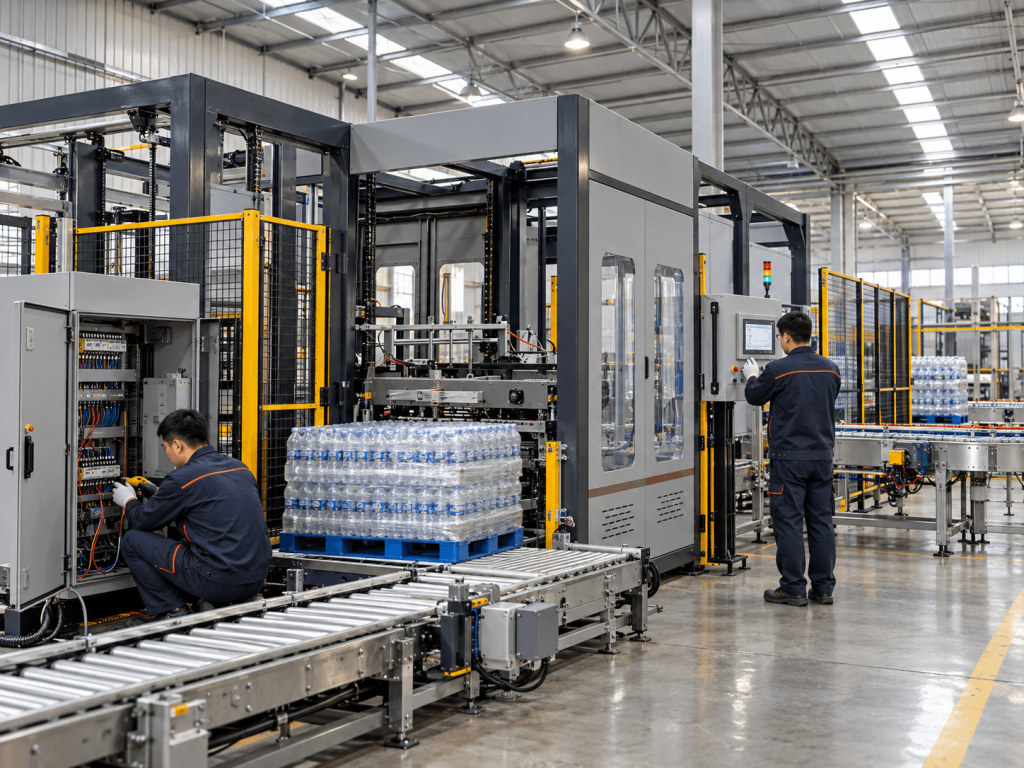
Installation & Commissioning
Mechanical, electrical and line-interface commissioning

Training & Support
Operation, maintenance and technical support
REAL ATOP PROJECTS
Integrated End-of-Line Automation in Real Production
Every end-of-line project has a different automation boundary. These ATOP projects show how palletizing, conveying, pallet handling and other downstream processes can be integrated around actual production requirements.
The value of an integrated system is not the number of machines—it is how effectively the complete production flow works together.
FEATURED INTEGRATED PROJECT
Integrated Palletizing & Finished Pallet Handling Line
This project was developed around the customer’s existing production flow, connecting product handling, automatic palletizing and finished pallet handling into one coordinated downstream system.
Actual Flow
Production Output→Product Conveying→Grouping / Preparation→Automatic Palletizing→Finished Pallet Transfer→Stretch Wrapping→Downstream Logistics
EXISTING-LINE UPGRADE
Palletizing Automation Added to an Existing Production Line
New palletizing and pallet-handling automation was integrated around the customer’s existing production equipment and site conditions.
- Existing Line Interface
- Product Conveying
- Automatic Palletizing
- Finished Pallet Handling
Integration without unnecessarily replacing existing upstream equipment.
MULTI-INFEED INTEGRATION
Coordinated Downstream Automation for Multiple Product Infeeds
Multiple incoming product flows were coordinated with downstream grouping, palletizing and pallet handling to support continuous production.
- Multiple Infeeds
- Product Distribution
- Palletizing
- Pallet Flow
High-Speed Page:How do we handle high output?
Complete EOL Page:How do we integrate multiple processes?
COMPLETE END-OF-LINE AUTOMATION FAQ
Questions Before Planning an Integrated End-of-Line System
Every end-of-line project has a different automation scope. The questions below cover several of the most common considerations when connecting packaging, conveying, palletizing, pallet handling and downstream logistics.
Still Have a Project-Specific Question?
Can ATOP integrate end-of-line automation with our existing production equipment?
Yes. An end-of-line system can often be designed around existing production or packaging equipment rather than replacing the complete line. We first evaluate the current product discharge, conveyor conditions, required output, available space and control interfaces before defining the appropriate integration scope.
Does all equipment in the complete line need to be supplied by ATOP?
No. ATOP focuses on palletizing, material handling and downstream automation, while additional packaging or logistics equipment can be integrated according to the project requirements. Existing customer equipment or suitable third-party equipment can also be considered when defining the complete system.
Where should end-of-line automation begin and end?
The automation boundary depends on the current production process and project objective. Some projects begin at the discharge of an existing packing machine and end after palletizing, while others may include case handling, labeling, conveying, palletizing, stretch wrapping, pallet transport and a downstream warehouse or AGV interface.
How do you determine the capacity of a complete end-of-line system?
System capacity should be evaluated from the complete production flow rather than the nominal speed of one machine. Upstream output, product format, number of infeed lines, accumulation, palletizing cycle, pallet change and finished pallet transfer can all affect overall line performance.
Can the system connect with stretch wrapping, AGVs or warehouse automation?
Yes. Finished pallet handling can be designed with defined interfaces for processes such as stretch wrapping, pallet conveying, AGV or AMR pickup and downstream warehouse handling. The exact interface depends on the equipment and logistics system used in the project.
What information do you need to prepare an end-of-line automation proposal?
To begin an initial evaluation, we normally need the product or package type, dimensions and weight, current and target output, pallet size and stacking requirements, existing production-line information and available site space.
A few photos, a short production video and an existing layout are often enough for the first discussion.
Planning an End-of-Line Automation Project?
Planning an End-of-Line Automation Project?
Tell us what you are producing, how your current line operates and what you want to automate. We can help evaluate the suitable system scope and integration approach around your actual production requirements.