
CRATES & TOTES HANDLING SYSTEMS
Automated Handling & Palletizing for Crates & Totes
Automated conveying, grouping and palletizing solutions for plastic crates, logistics totes and reusable containers. Engineered around your crate type, production requirements, pallet pattern and existing line conditions.
WHAT ARE YOU HANDLING?
Different Crates, Totes & Reusable Containers
Crates and totes vary in size, structure, material and stacking behavior. ATOP handling systems can be engineered around different reusable container formats and the way they need to be conveyed, grouped and palletized.

01
Plastic Crates
Open or closed-bottom plastic crates used in food, beverage, agriculture and general production.

02
Logistics Totes
Standard or customized reusable totes for internal handling, warehousing and distribution.
03
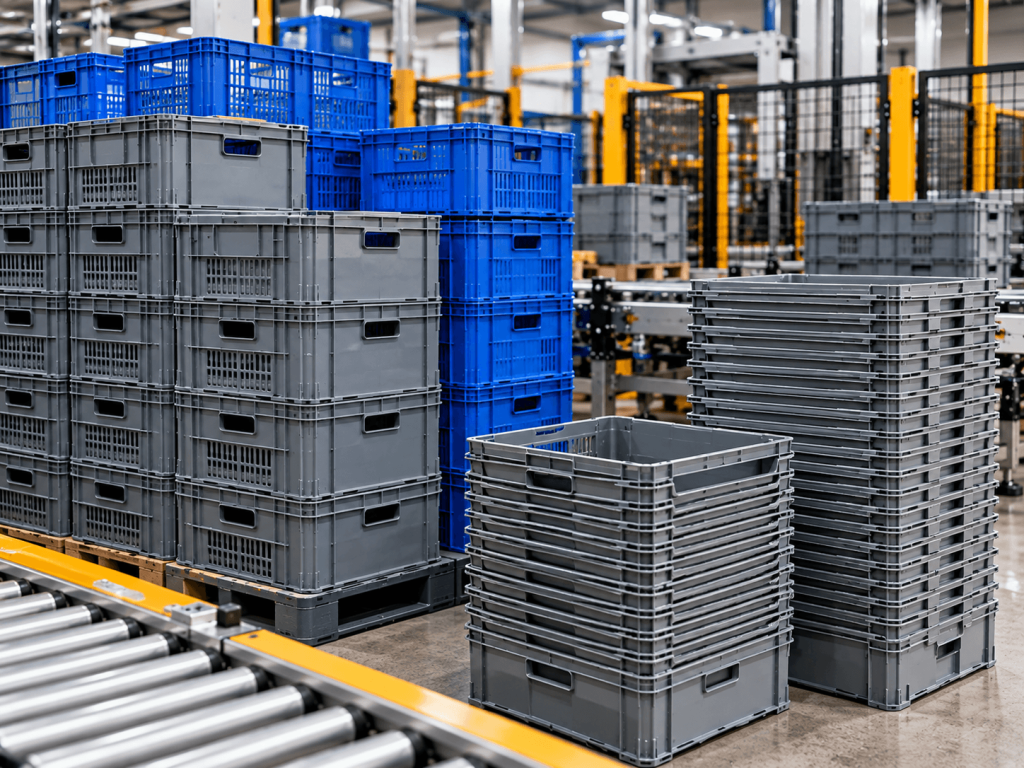
Stackable & Nestable Containers
Containers designed to stack when loaded or nest when empty, requiring different conveying and handling strategies.

04
Palletized Crate Loads
Single- or multi-layer crate arrangements built on plastic or wooden pallets for downstream handling and logistics.
WHY DOES THE CRATE TYPE MATTER?
Container structure, bottom design, stacking behavior and whether the crate is empty or loaded can directly affect conveying, grouping, gripping and palletizing.
WHY CRATES & TOTES NEED DIFFERENT HANDLING
More Than Just a Box
Crates and totes may look simple, but differences in structure, bottom design, stacking behavior and load condition can directly affect how they should be conveyed, grouped, gripped and palletized.
The handling method should therefore be selected around the actual container and required pallet pattern rather than the product category alone.
Logistics Totes
Bag dimensions, weight, material, surface condition and product behavior all affect conveying, gripping and pallet stability.
SIZE · MATERIAL · BOTTOM DESIGN
Empty or Full Condition
Empty and loaded crates can behave differently during conveying and handling, especially when product weight changes the stability of the container.
EMPTY · LOADED · WEIGHT
Stacking / Nesting
Some containers stack directly while others nest when empty. The container state can change the required separation, positioning and palletizing process.
STACKABLE · NESTABLE · SEPARATION
Pallet Pattern & Stability
Layer arrangement, interlocking pattern, pallet dimensions and final stack height should be considered together to create a stable finished load.
PATTERN · PALLET · STACK HEIGHT
Why do crates and totes require application-specific handling?
Crates and totes differ in dimensions, structure, bottom design, load condition and stacking behavior. These characteristics can affect conveying stability, positioning, gripping, layer formation and palletizing, so the handling method should be selected around the actual container and final pallet requirements.
HOW THE SYSTEM WORKS
From Crate Infeed to Finished Pallet
A complete handling process can integrate crate conveying, positioning, grouping, pallet supply, automatic palletizing and finished pallet transport according to the crate type and production requirements.
01
→

Crate Infeed & Alignment
Crates enter from the upstream production or logistics process and are guided into a controlled position for downstream handling.
02
→

Grouping / Layer Formation
Crates are positioned and grouped into the required row or layer arrangement according to the pallet pattern.
03
→
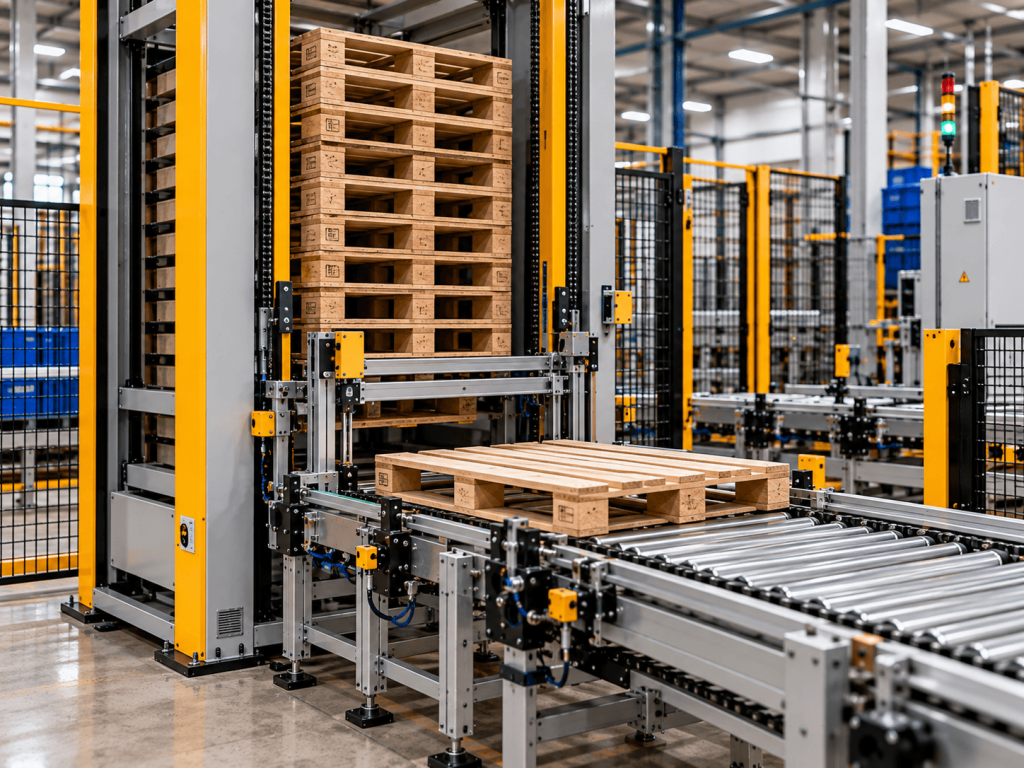
Empty Pallet Supply
Empty pallets are supplied and transferred automatically to the palletizing position for continuous production.
04
→
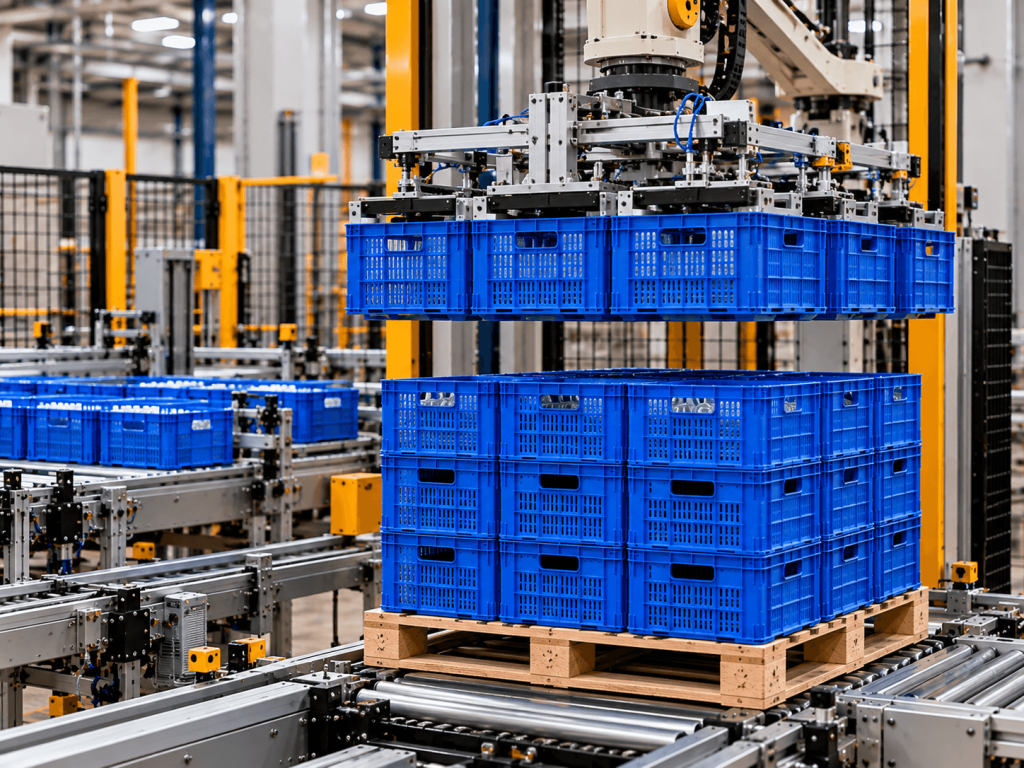
Automatic Palletizing
The prepared crates are automatically placed onto the pallet using the selected robotic or layer-handling configuration.
05

Finished Pallet Outfeed
The completed crate load is transferred downstream by pallet conveyor for storage, wrapping or further logistics handling.
WHAT IF THE CRATES ARE EMPTY OR NESTED?
Empty or nested crates may require a different handling sequence, including separation, denesting, orientation or stacking before palletizing. The process should be defined according to the actual crate design and return-logistics requirement.
HANDLING CONFIGURATIONS
Which Configuration Fits Your Crate & Tote Application?
The right automation approach depends on the crate format, production flow, required pallet pattern, handling condition and available space. Different applications may use robotic handling, layer-based palletizing or dedicated empty-container handling.

FLEXIBLE HANDLING
Robotic Crate Palletizing
A flexible handling approach for crate and tote applications where product formats, pallet patterns or production requirements may vary.
Best evaluated when:
- Multiple crate or tote formats
- Different pallet patterns
- Individual or grouped handling is required
- Flexible production layouts are important
CONTINUOUS PALLETIZING
Layer Crate Palletizing
A layer-based approach for repeatable crate formats and continuous production where products can be organized into complete rows or layers before palletizing.
Best evaluated when:
- Stable and repeatable crate formats
- Continuous production flow
- Complete rows or layers can be formed
- Repeatable pallet patterns are required

RETURNABLE CONTAINER FLOW
Empty Crate & Tote Handling
A dedicated handling approach for empty, stackable or nestable containers that may require separation, orientation, stacking or return-flow automation.
Best evaluated when:
- Empty containers return to production
- Crates or totes are nested for transport
- Automatic separation or stacking is required
- Return logistics must connect with the production line
HOW DO WE SELECT THE RIGHT CONFIGURATION?
The Container and Production Flow Should Be Evaluated Together
The suitable configuration is determined by more than the required output alone. Crate structure, load condition, stacking behavior, pallet pattern, return flow and available site conditions should be evaluated together.
ENGINEERED AROUND YOUR LINE
What Determines the Right Crate & Tote Handling System?
A reliable system starts with the actual container and production conditions. Crate structure, load condition, stacking behavior, production flow, pallet requirements and existing equipment should be evaluated together before the final configuration is defined.
01
Container Dimensions & Structure
Crate length, width, height, material, wall design and bottom structure affect conveying, positioning and gripping.
SIZE · STRUCTURE · MATERIAL
02
Empty or Loaded Condition
Empty and loaded containers can differ significantly in weight and stability, which can affect the required handling method.
EMPTY · LOADED · WEIGHT
03
Stacking & Nesting Behavior
Stackable, nestable or interlocking designs can require different separation, grouping and palletizing processes.
STACKABLE · NESTABLE · INTERLOCKING
04
Production Flow & Output
Required output, number of incoming lines and crate accumulation conditions help determine how the system should be arranged.
OUTPUT · INFEED · ACCUMULATION
05
Pallet & Load Requirements
Pallet dimensions, layer pattern, stack height and finished-load stability should be defined around the downstream logistics requirement.
PALLET · PATTERN · STACK HEIGHT
06
Existing Line & Site Conditions
Conveyor height, upstream and downstream equipment, available floor space and control interfaces should be reviewed before the final layout is defined.
LAYOUT · CONVEYOR · INTERFACE
WHAT INFORMATION HELPS US EVALUATE YOUR APPLICATION?
Send Us the Basic Information About Your Crates and Line
You do not need a complete technical specification. A few basic container details together with photos or a short production-line video are usually enough to begin an initial application review.
01
Container
Dimensions + Material
02
Load
Empty / Loaded + Weight
03
Production
Required Output
04
Pallet
Size + Stack Height
05
Existing Line
Upstream / Downstream Equipment
06
Site
Photos / Video / Layout
REAL ATOP PROJECTS
Crate & Tote Handling in Real Production Lines
See how different crate formats, production conditions and pallet requirements are handled in actual automation projects.
FEATURED PROJECT · CRATE PALLETIZING
Automated Plastic Crate Palletizing System
An automated handling and palletizing solution designed around the actual crate format, incoming product flow and required pallet arrangement.
PROJECT FLOW
Crate Infeed → Positioning → Grouping → Automatic Palletizing → Finished Pallet Outfeed
ROBOTIC HANDLING
Robotic Crate Palletizing
Robotic handling for crate applications requiring flexible gripping, product grouping or different pallet arrangements.
PRODUCT
Plastic Crates / Totes
HANDLING
Robotic Gripping
FINAL LOAD
Pallet
RETURNABLE CONTAINER HANDLING
Empty Crate Return & Handling
Automated handling for empty or returnable crates requiring conveying, stacking, separation or connection with the production flow.
FREQUENTLY ASKED QUESTIONS
Common Questions About Crate & Tote Automation
From crate compatibility to palletizing methods and existing-line integration, these are some of the common questions we evaluate when planning a crate and tote handling system.
Have a different application?
Can one system handle different crate or tote sizes?
Yes, depending on the differences between the container formats and the selected handling method. Dimensions, bottom structure, weight, stacking behavior and pallet pattern should be evaluated to determine whether the formats can share the same system and what changeover is required.
Can the system handle both empty and loaded crates?
Yes, but empty and loaded crates may require different handling considerations. Product weight, container rigidity, conveying stability and gripping conditions can change significantly once a crate is loaded. The system should therefore be evaluated around the actual operating condition.
Should I use robotic or layer palletizing for crates?
The suitable method depends on the crate format, production flow, pallet pattern, required flexibility and site conditions. Robotic palletizing can provide flexible handling for different formats or patterns, while layer-based systems can be suitable for repeatable applications where complete rows or layers can be formed before palletizing.
Can pallet handling be integrated with the crate palletizing system?
Yes. Depending on the project scope, the system can integrate empty pallet supply, pallet conveying and finished pallet outfeed together with the crate handling and palletizing process.
Can the system connect with my existing production line?
Yes. A crate or tote handling system can be engineered to interface with existing upstream and downstream equipment. Conveyor height, infeed direction, available floor space, production flow and control interfaces should be reviewed before the final layout is defined.
What information do you need to propose a crate or tote handling system?
Start with the container dimensions, material, empty or loaded weight, required production output, pallet size, desired stack height and information about the existing line. Photos, videos or a simple layout drawing can also help us evaluate the application.
If complete technical data is not yet available, a few container photos and a short production-line video are enough to begin the initial discussion.
START YOUR PROJECT
Planning a Crate or Tote Automation Project?
Tell us what you are handling and how your current line operates. Our team can help evaluate the suitable handling, palletizing and pallet-flow configuration around your actual production requirements.
You do not need a complete technical specification to get started.
Product & Packaging
Product type, dimensions, weight and packaging format..
Required Output
Target production capacity, line speed or peak output.
Pallet Requirements
Pallet dimensions, stacking pattern and required load height.
Line Layout
Available floor space, layout drawings or existing line photos.