
BOTTLES, DRUMS & CONTAINERS
Automated Handling & Palletizing for Bottles, Drums & Containers
Automated solutions for bottles, drums, pails and rigid containers handled directly by the system — engineered around product stability, orientation, gripping method, production requirements and final load format.
WHAT ARE YOU HANDLING?
Different Containers Need Different Handling Methods
This solution category focuses on bottles, drums, pails and other rigid containers handled directly by the automation system. Different container shapes, materials and handling requirements may require different conveying, gripping, orientation and loading methods.

01
Bottles & Rigid Containers
Bottles, jars and other rigid containers handled directly before palletizing or downstream loading.

02
Large Water Bottles
Large reusable water bottles requiring stable conveying, controlled orientation and application-specific handling.

03
Drums & Pails
Industrial drums and pails evaluated around container weight, dimensions, surface conditions and required stacking method.

04
Specialty Rigid Containers
Jerry cans and other application-specific rigid containers requiring dedicated handling, positioning or palletizing methods.
DIRECT CONTAINER HANDLING
The Container Itself Defines the Handling Strategy
Unlike cases or shrink packs, bottles, drums and rigid containers are handled directly by the automation system. Their shape, stability, surface, orientation and final loading method can directly affect how they should be conveyed, grouped, gripped and placed.

01
Product Stability
Container height, base geometry, center of gravity and product weight can affect conveying stability, spacing and transfer between different handling stages.
HEIGHT · BASE · CENTER OF GRAVITY
02
Orientation & Positioning
Some containers can remain upright throughout the process, while others may need alignment, turning or controlled orientation before palletizing or loading.
ALIGNMENT · TURNING · POSITIONING
03
Gripping Method
The handling tool should be selected around the container shape, material, available contact surface, product weight and required pick pattern.
SHAPE · SURFACE · PICK PATTERN
04
Pallet or Rack Loading
The required final load determines how products must be grouped and placed — whether building a pallet load, loading a dedicated rack or connecting with another downstream handling process.
PALLET · RACK · DOWNSTREAM
HOW THE SYSTEM WORKS
Different Containers Require Different Handling Processes
The handling sequence depends on the container format and required final load. Some applications are organized and palletized onto a conventional pallet, while others require dedicated orientation, rotation and rack-loading processes.
PALLETIZING PROCESS ━
Conventional Pallet Loading
For bottles, drums, pails and other rigid containers that can be organized and stacked directly onto a pallet.
01
→

Container Infeed
Containers enter the handling system from the upstream production line.
02
→

Conveying & Positioning
Containers are guided, spaced and aligned for controlled downstream handling.
03
→
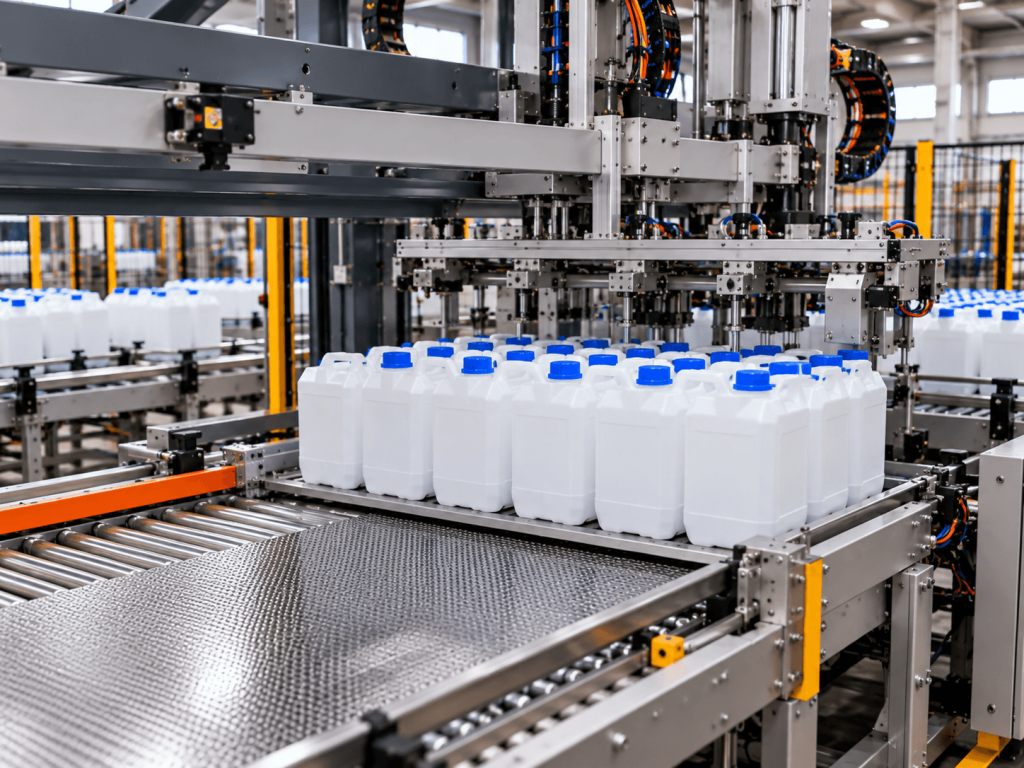
Row / Layer Formation
Products are grouped into the required arrangement for automatic handling.
04
→
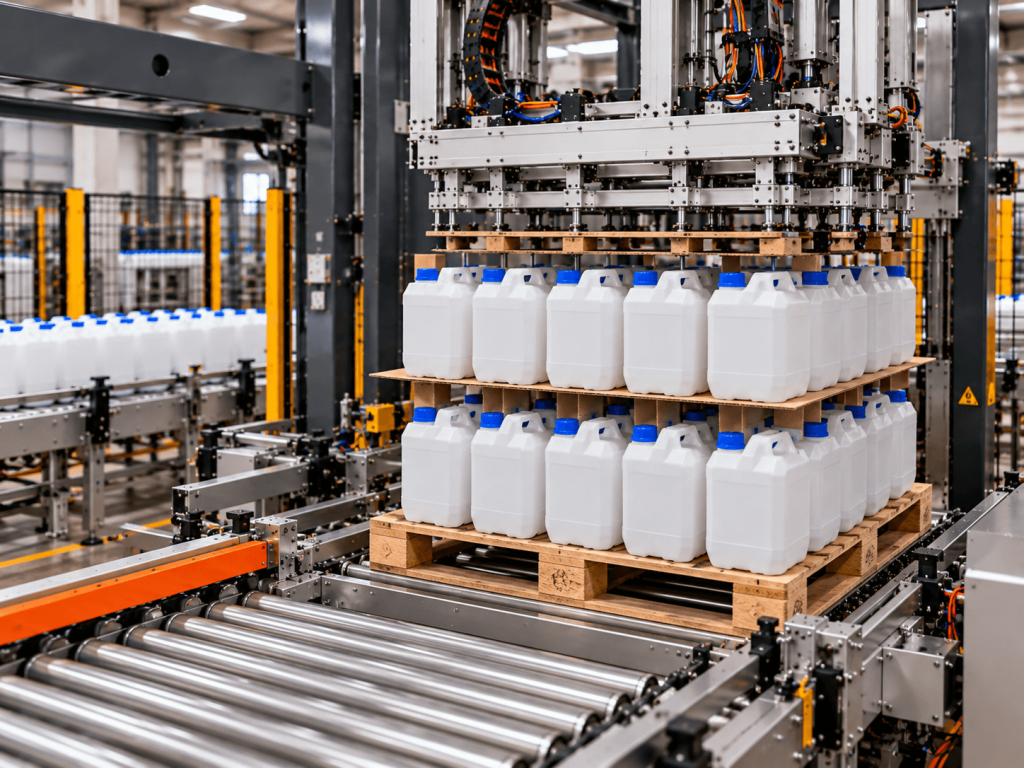
Automatic Palletizing
The gripping system picks and places the prepared containers according to the pallet pattern.
05

Finished Pallet Outfeed
The completed pallet is transferred downstream for further handling or logistics.
NOT EVERY CONTAINER ENDS ON A PALLET
Some applications require a completely different final handling method.
━━━━
━━━━
SPECIALIZED HANDLING PROCESS ━
90° Rotation & Rack Loading
For large reusable water bottles that require complete-row gripping, controlled orientation change and horizontal loading into a dedicated rack.
01
→
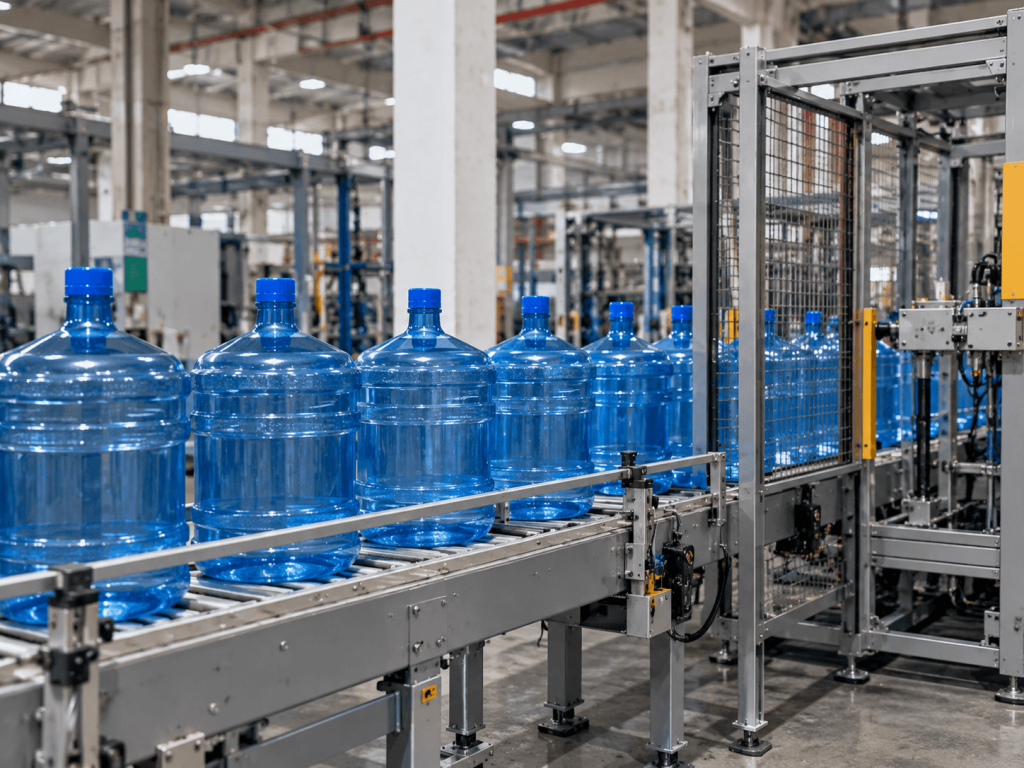
Bottle Infeed
Containers enter the handling system from the upstream production line.
02
→
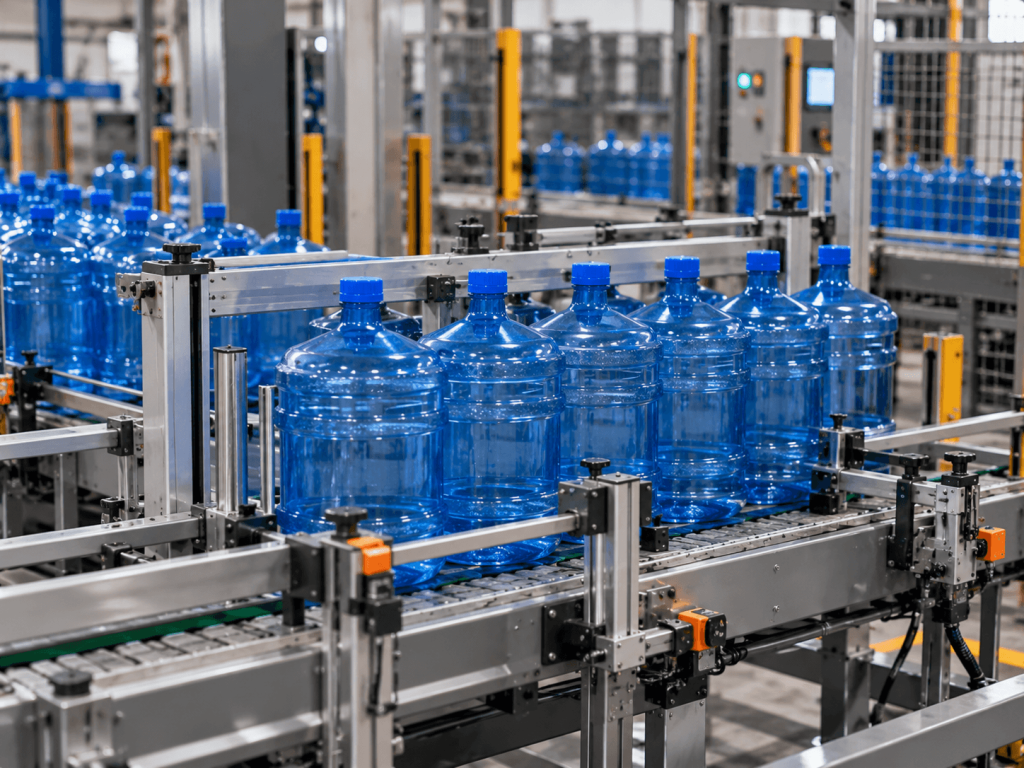
Row Alignment
Containers are guided, spaced and aligned for controlled downstream handling.
03
→
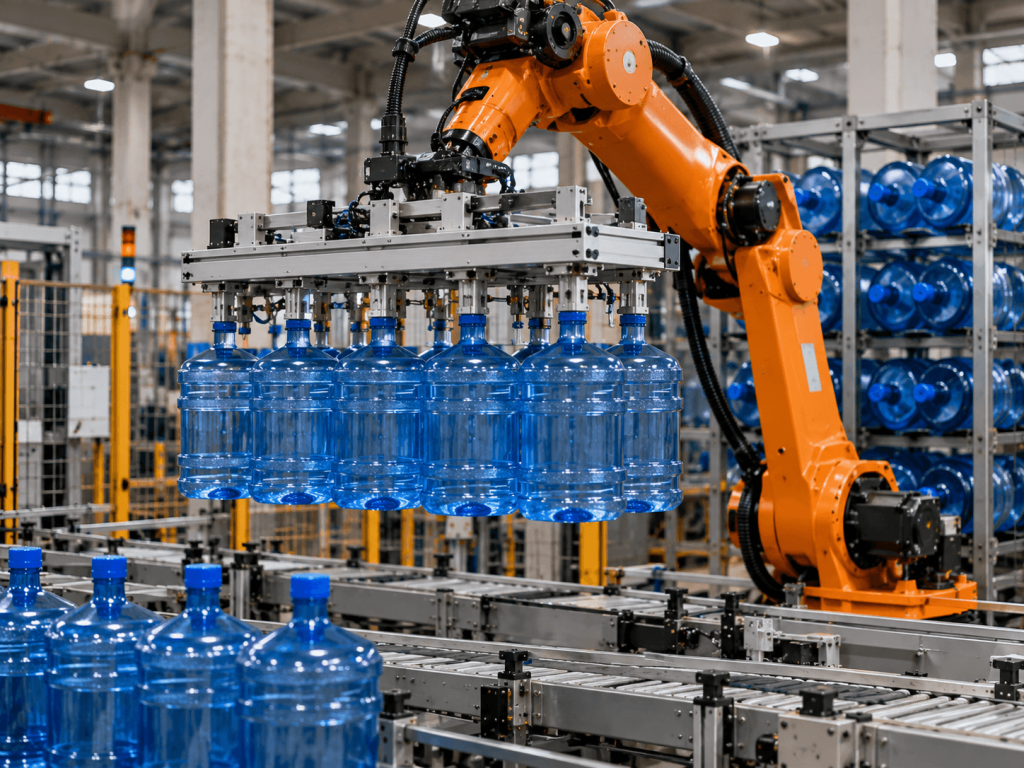
Robotic Row Gripping
Products are grouped into the required arrangement for automatic handling.
04
→
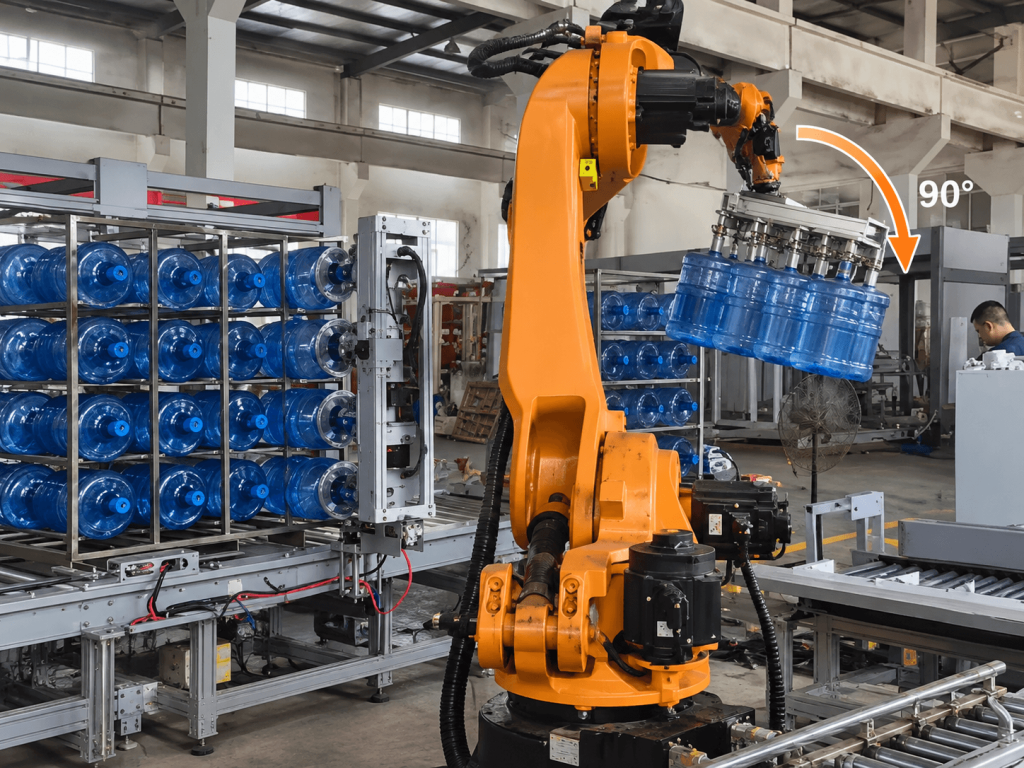
90° Rotation
The gripping system picks and places the prepared containers according to the pallet pattern.
05
→
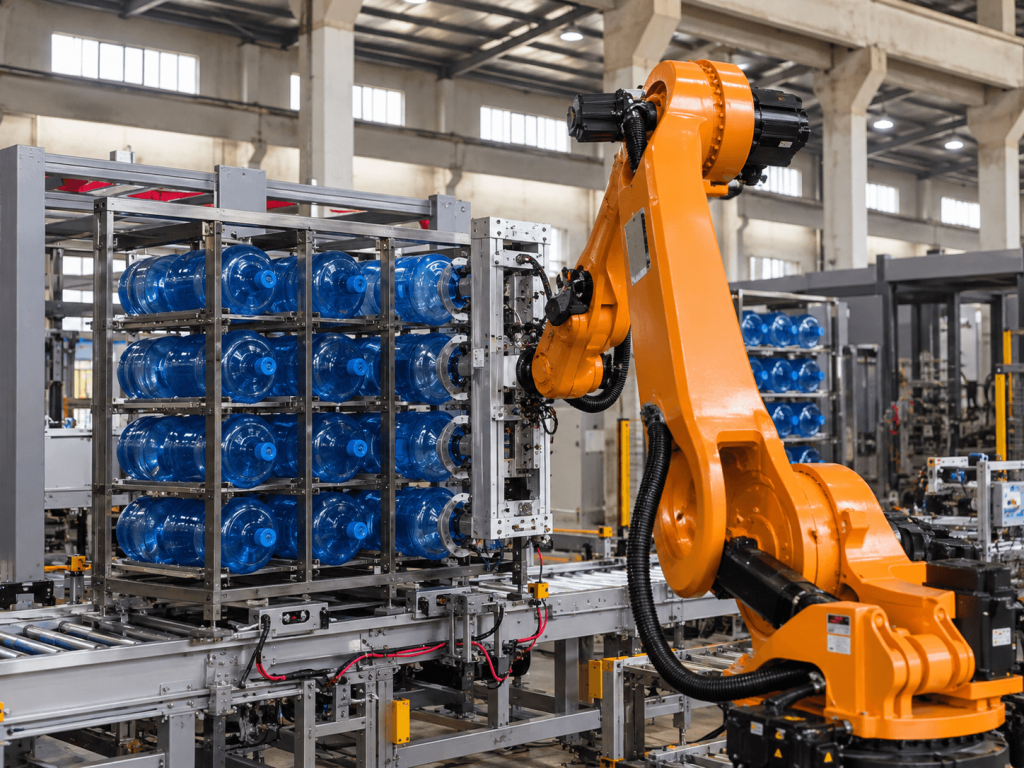
Rack Loading
The completed pallet is transferred downstream for further handling or logistics.
06
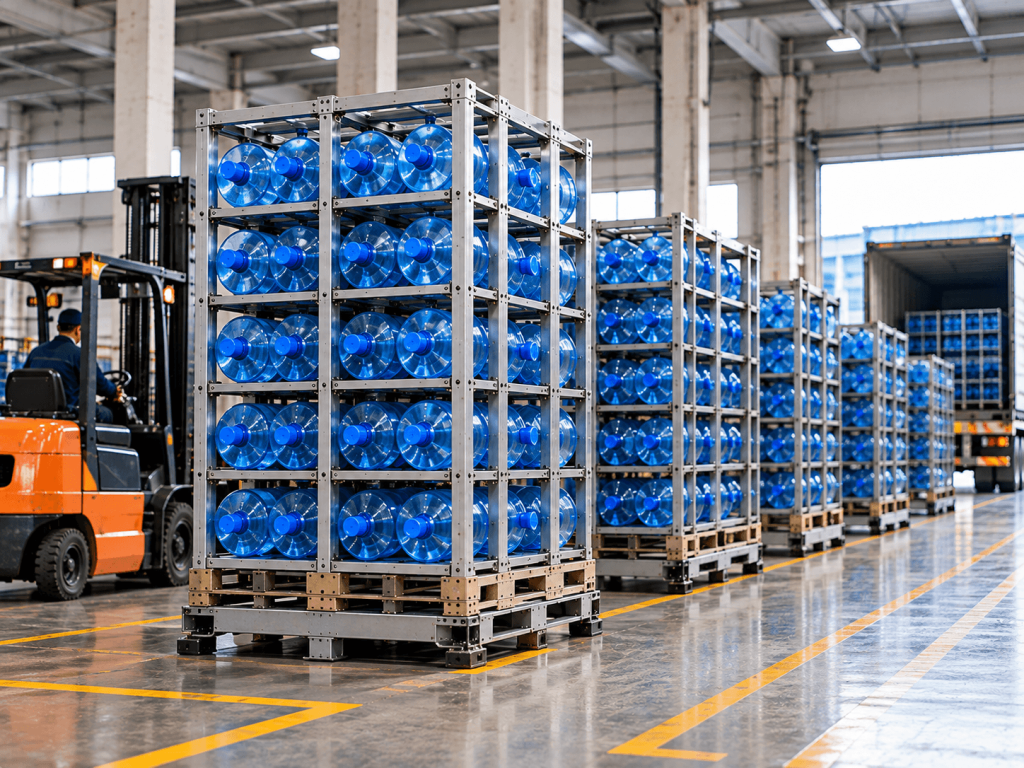
Loaded Rack Outfeed
The filled rack is transferred out for the next handling or logistics process.
Which Handling Process Is Right for My Container?
The correct process depends on how the product arrives from the upstream line, whether orientation must change, how multiple containers should be grouped, and whether the finished load is built on a pallet, loaded into a rack or transferred to another downstream process.
HANDLING CONFIGURATIONS
Which Automation Configuration Fits Your Application?
The right configuration depends on the container format, required output, handling pattern, final load type and available production space. ATOP evaluates these conditions together before defining the handling and palletizing approach.
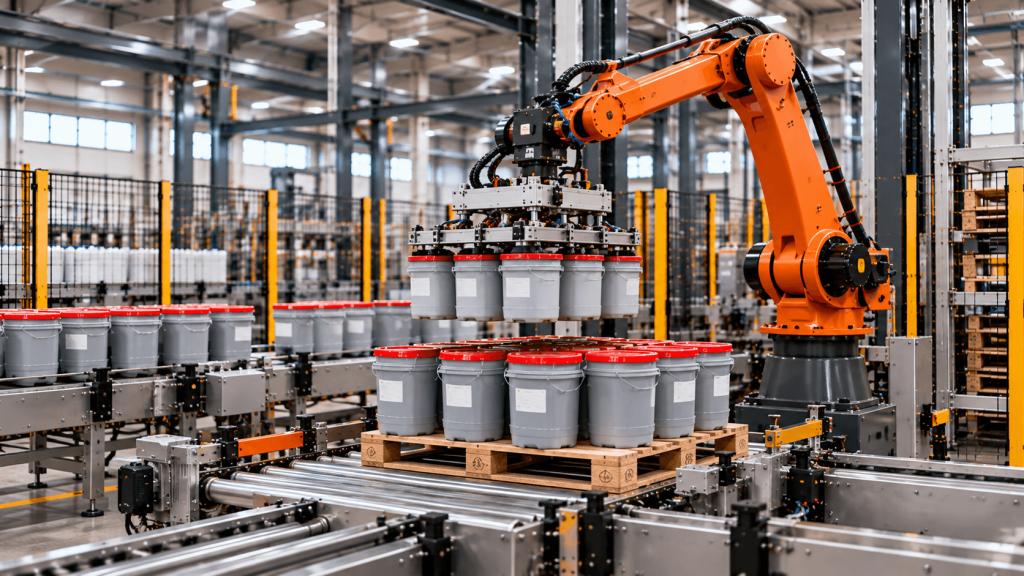
FLEXIBLE HANDLING
Robotic Palletizing
A flexible approach for drums, pails and rigid containers where product handling, pallet patterns or production requirements may vary.
Best evaluated when:
- Multiple container formats or SKUs are involved
- Flexible pallet patterns are required
- Individual or grouped picking is suitable
- Production layout requires an adaptable configuration

CONTINUOUS PRODUCTION
Layer Palletizing
A layer-based approach for stable container formats and continuous production where coordinated product arrangement and repeatable pallet formation are important.
Best evaluated when:
- Container specifications are relatively stable
- Production runs continuously
- Products can be organized into rows or layers
- Repeatable pallet patterns are required
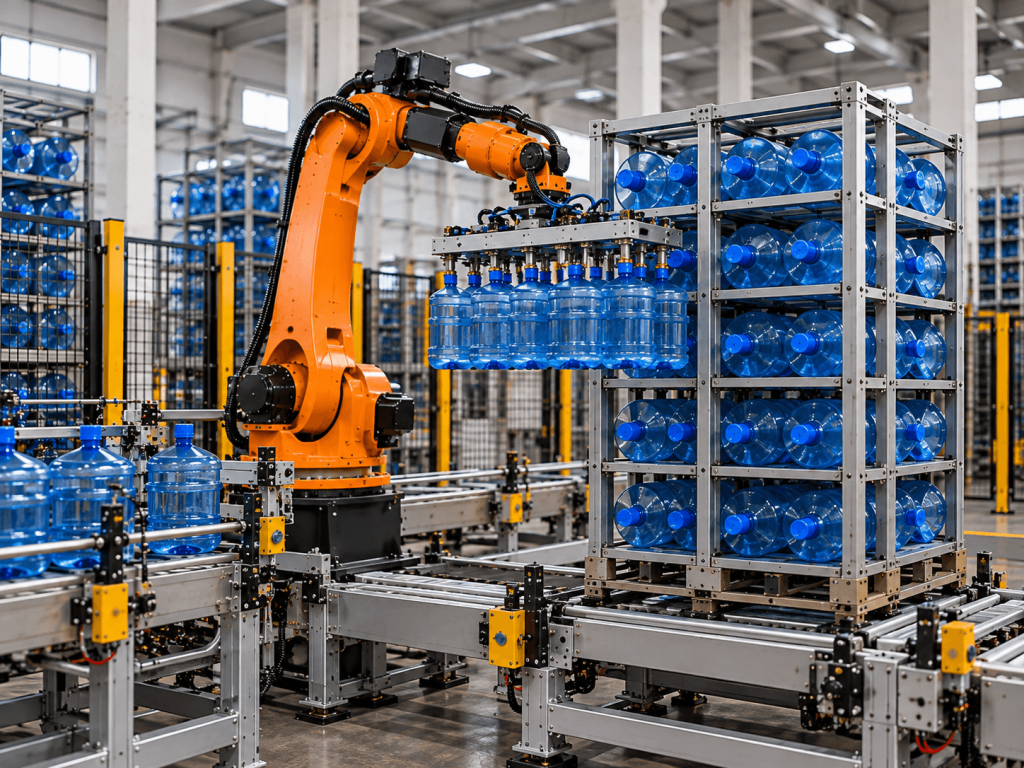
APPLICATION-SPECIFIC HANDLING
Specialized Container Handling
A dedicated handling approach for containers that require orientation changes, special gripping, rack loading or other application-specific movements beyond conventional palletizing.
Best evaluated when:
- Product orientation must change during handling
- Dedicated gripping is required
- The final load is not a conventional pallet
- Rack loading or special placement is required
HOW DO WE SELECT THE RIGHT CONFIGURATION?
The correct configuration is determined by the complete application rather than one parameter alone. Container characteristics, required output, handling pattern, final load format, existing equipment and available factory space should be evaluated together.
ENGINEERED AROUND YOUR LINE
What Determines the Right Container Handling System?
A reliable handling system starts with the actual container and production conditions. Container geometry, stability, gripping surface, production flow, final load requirements and existing equipment should be evaluated together before the system configuration is defined.
01
Container Geometry
Dimensions, shape, handles, openings and structural features affect how the container can be guided, grouped and gripped.
SIZE · SHAPE · HANDLE / NECK
02
Stability & Contact Surface
Base geometry, center of gravity, surface condition and available gripping areas influence conveying stability and the suitable handling method.
BASE · CENTER OF GRAVITY · GRIPPING SURFACE
03
Production Flow & Output
Required output, incoming product arrangement and the number of production lines determine how containers should be accumulated and prepared for handling.
OUTPUT · INFEED · PRODUCT FLOW
04
Handling & Grouping Method
Depending on the application, containers may be handled individually, in groups, by complete rows or as prepared layers.
INDIVIDUAL · GROUP · ROW · LAYER
05
Final Load Requirements
Pallet dimensions, stacking pattern, divider sheets, load height or dedicated rack requirements determine how the final load should be formed.
PALLET · DIVIDER SHEET · RACK
06
Existing Line & Site Conditions
Upstream equipment, conveyor height, available floor space, ceiling height and downstream handling should be reviewed before the final layout is defined.
EQUIPMENT · LAYOUT · INTERFACE
HOW DO WE SELECT THE RIGHT CONFIGURATION?
The correct configuration is determined by the complete application rather than one parameter alone. Container characteristics, required output, handling pattern, final load format, existing equipment and available factory space should be evaluated together.
WHAT INFORMATION HELPS US EVALUATE YOUR APPLICATION?
Send Us the Basic Information About Your Container and Line
You do not need a complete technical specification. A product photo or video together with several basic dimensions and production requirements is usually enough to begin an initial application review.
01
Container
Dimensions + Weight
02
Production
Required Output
03
Handling
Current Product Flow
04
Final Load
Pallet / Rack / Load Height
05
Existing Line
Upstream & Downstream Equipment
06
Site
Photos / Video / Layout
Real ATOP Projects
Container Handling Systems in Real Production Lines
Real ATOP projects show how different containers require different handling approaches — from conventional palletizing to dedicated gripping, orientation and rack-loading processes.
Actual system configurations are engineered according to the product, production requirements, final load format and site conditions.
FEATURED PROJECT · LARGE WATER BOTTLES
Large Water Bottle 90° Rotation & Rack Loading
A dedicated robotic handling system for large reusable water bottles. Bottles are aligned into a complete row, gripped simultaneously, rotated 90° from upright to horizontal orientation, and accurately loaded into the required rack level.
PROJECT FLOW
Bottle Infeed → Row Alignment → Full-Row Gripping → 90° Rotation → Rack Loading → Rack Outfeed
CONVENTIONAL PALLETIZING
Conventional Container Palletizing System
A conventional palletizing solution for rigid containers that can be conveyed, arranged and stacked in a stable pallet pattern using a standard layer-based handling process.
APPLICATION
Rigid Bottles / Containers
HANDLING METHOD
Row or Layer Formation
FINAL LOAD
Conventional Pallet
ROTARY HANDLING
Rotary Container Palletizing System
A rotary handling configuration for container applications where product orientation must be changed before final placement, allowing the load pattern to be formed according to the required stacking or loading direction.
APPLICATION
Rigid Containers / Large Bottles
HANDLING METHOD
Controlled Rotation & Placement
FINAL LOAD
Application-Specific Arrangement
FREQUENTLY ASKED QUESTIONS
Questions About Bottle, Drum & Container Handling
Common questions when evaluating automated handling and palletizing systems for bottles, drums, pails and other rigid containers.
Not Sure Which Handling Method Fits Your Product?
Send us a product photo or short video together with the basic dimensions, weight and production requirements. Our engineering team can help evaluate the suitable handling approach.
Can one system handle different bottle, drum or container sizes?
Yes, depending on the differences between the container formats and the selected handling method. Container dimensions, weight, shape, gripping surface, stability and required pallet pattern should be evaluated together. For multi-format production, the required changeover method should also be considered during system design.
How do you choose between robotic and layer palletizing?
The selection depends on the complete application. Robotic palletizing can provide greater flexibility for different container formats, handling patterns or production requirements, while layer palletizing can be suitable for stable container formats and continuous production. Required output, grouping method, pallet pattern and available space should be evaluated together.
When are divider sheets required between pallet layers?
Divider sheets may be used when the container geometry or stacking surface does not provide sufficient layer-to-layer stability. Their use depends on the container shape, load pattern, pallet height and required load stability, and should be evaluated for the specific application.
Can the system rotate or reorient containers before loading?
Yes. For applications that require a different final orientation, the handling system can be engineered with dedicated gripping and orientation functions. For example, ATOP’s large water bottle handling application uses complete-row gripping and a 90° orientation change before horizontal rack loading.
Can the system connect to my existing filling or packaging line?
Yes. The handling and palletizing system can be engineered to interface with compatible existing upstream equipment and conveyors. Product discharge conditions, conveyor height, line speed, control interface and available layout should be reviewed before the final system configuration is defined.
What information do you need to evaluate my container handling project?
An initial evaluation normally requires the container dimensions and weight, required production rate, current product flow, pallet or rack information, available layout and details of the existing upstream and downstream equipment. Product photos, videos and a current line layout are especially helpful.
START YOUR PROJECT
Tell Us What Your Line Needs to Handle
Share your container specifications, production requirements, final load format and current line conditions. Our engineering team can use these details to evaluate a suitable handling, palletizing or rack-loading approach for your application..
Product photos, short videos or an existing line layout can help us understand the application more accurately.