
Palletizing 5L bottled water is not simply a larger version of palletizing small beverage packs.
In the ATOP system shown in the video below, six 5L bottles are arranged in a 2×3 packaging format before entering the palletizing process. The system coordinates product handling, layer formation, automatic interlayer-sheet placement, pallet movement and stretch wrapping to produce a stable finished load.
The engineering challenge is not only lifting a heavier package. A reliable 5L bottled water palletizing system must also control pack deformation, product alignment, layer transfer, pallet accuracy and load stability throughout the complete end-of-line process.
Important clarification: “2×3” describes the arrangement of the six bottles inside each packaging unit. It does not describe the number of packs placed on each pallet layer. The final pallet pattern must be calculated separately.
Watch the ATOP 5L 2×3 Palletizing System
Insert the YouTube video here:
Watch the ATOP 5L 2×3 bottled water palletizing system
The video demonstrates several connected functions:
- Handling of 5L bottled-water packs
- Product positioning and layer preparation
- Automatic palletizing
- Vacuum-assisted interlayer-sheet placement
- Pallet lifting and positioning
- Finished-load stretch wrapping
The exact production speed, pallet pattern and number of layers are configured according to the customer’s package dimensions, pallet size, required output and logistics conditions.
What Does 5L 2×3 Packaging Mean?
A 2×3 pack contains two rows of three bottles, giving a total of six 5L bottles in one secondary packaging unit.
The water content alone weighs approximately 30 kg. Once the PET bottles, caps, labels and packaging film are included, the complete pack weighs more than the water itself.
This makes the package considerably heavier than a conventional small-bottle beverage pack.
The palletizing system must therefore be designed around:
- Actual pack dimensions and total weight
- Strength and tension of the shrink film
- Bottle movement inside the pack
- Condition of the pack bottom
- Conveyor support and transfer gaps
- Required pallet pattern
- Number of layers and final pallet height
- Downstream wrapping and handling conditions
The package should be tested as a complete unit. Bottle volume alone is not enough to select the conveyor, layer-forming method or palletizing mechanism.

Why Are 5L Shrink Packs More Difficult to Palletize?
Higher Package Weight
A six-bottle 5L pack contains approximately 30 litres of water. This concentrated weight affects conveyor selection, stopping distance, product accumulation and the force applied during layer formation.
Sudden starts, stops or directional changes can cause the bottles to move inside the film or make the entire package lose alignment.
The system should use controlled movement rather than relying only on high conveyor speed.
Flexible Secondary Packaging
Unlike a rigid carton, a shrink-wrapped bottle pack can deform when it is pushed, stopped or compressed.
The film holds the bottles together, but it does not always create a perfectly rigid rectangular package. If the pack is handled too aggressively, the bottle positions may shift and affect the layer pattern.
This is why the strength and condition of the packaging film must be evaluated during the engineering stage.
Higher Centre of Gravity
Large bottles are taller than small beverage containers. When several heavy packs are stacked into a multi-layer pallet load, small alignment errors at the bottom can become more significant at the top.
The final load must remain stable not only while it is inside the palletizer, but also during:
- Full-pallet conveyor transfer
- Stretch wrapping
- Forklift or AGV pickup
- Warehouse movement
- Truck or container transportation
Pack-to-Pack Variation
Shrink-film tension, bottle filling accuracy, pack temperature and upstream packaging conditions can cause small dimensional variations.
A palletizing system should allow for realistic production tolerances instead of being designed only around the nominal package dimensions shown on a drawing.
How the 5L Bottled Water Palletizing Process Works
1. Product Infeed and Controlled Conveying
Completed 2×3 packs arrive from the upstream packaging equipment.
The infeed conveyor transfers the packs toward the palletizer while maintaining the correct orientation and spacing. Guide rails, stops, sensors and accumulation logic help keep the product flow controlled.
For a heavy 5L package, conveyor transitions require particular attention. Excessive gaps, unsupported edges or sudden impacts can deform the pack or disturb the bottle arrangement.
2. Pack Positioning and Layer Formation
The incoming packs are arranged according to the programmed pallet pattern.
Depending on the required layer design, the system may position, turn or sequence individual packs before forming a complete row or layer. The purpose is to use the pallet surface effectively while creating sufficient interlocking between adjacent layers.
A suitable pallet pattern should consider:
- Package length and width
- Pallet dimensions
- Overhang and underhang
- Pack orientation
- Layer-to-layer interlocking
- Total pallet height
- Load distribution
- Forklift and transport conditions
The pattern should not be selected only to maximize the number of packs per pallet. Load stability and downstream handling are equally important.
3. Complete-Layer Palletizing
After the required arrangement has been formed, the prepared layer is transferred to the palletizing position.
Layer-based handling can be effective for a stable, repeatable packaging format because the products are organized before placement. This supports consistent alignment and repeatable pallet formation during continuous production.
However, the appropriate palletizer type still depends on the complete application. Production speed, SKU quantity, changeover frequency and available floor space must all be considered.
Learn more about ATOP high-level palletizing systems.
4. Pallet Lifting and Accurate Positioning
The video also shows a pallet lifting or positioning mechanism beneath the load.
This mechanism coordinates the pallet height with the layer-transfer process. Accurate vertical positioning helps reduce the drop distance between the prepared layer and the existing pallet load.
Reducing uncontrolled drop height can help maintain:
- Pack alignment
- Layer position
- Bottle stability
- Consistent stack height
- A flatter load surface
The lifting sequence must remain synchronized with the layer-forming and transfer mechanisms.
5. Automatic Interlayer-Sheet Placement
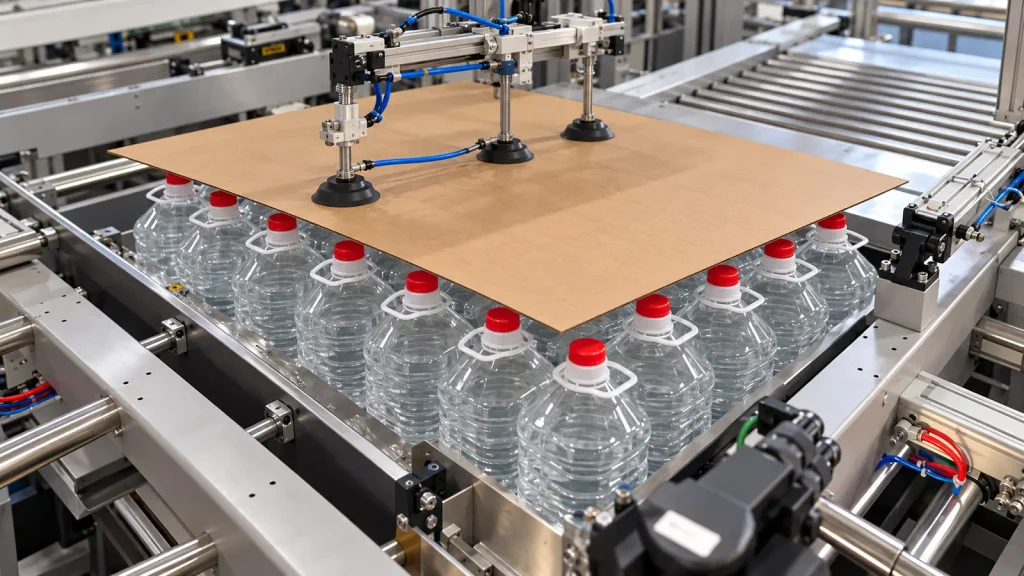
An automatic vacuum tool picks and places a sheet between selected pallet layers.
These sheets are also commonly described as interlayer sheets, tier sheets or slip sheets. Depending on the application, they can help:
- Increase friction between layers
- Separate packaging surfaces
- Distribute contact pressure
- Reduce relative movement
- Support a more stable finished load
The video shows suction cups lifting the sheet and positioning it over the palletized products.
Sheet handling must be matched to the real material. Thickness, surface finish, stiffness, porosity, flatness and static electricity can all affect vacuum pickup reliability.
Not every 5L pallet requires a sheet between every layer. The final sheet strategy should be determined through load testing and customer logistics requirements.
6. Repeating the Pallet Pattern
The system repeats the programmed sequence until the required number of layers or final pallet height is reached.
Alternating the orientation of successive layers can improve interlocking in some applications. In other applications, the same pattern may be repeated with interlayer sheets.
The correct arrangement depends on the package and pallet—not on a universal palletizing rule.
7. Stretch Wrapping the Finished Pallet
After palletizing, the completed load is secured with stretch film.
For tall or heavy 5L water loads, wrapping should be treated as part of the engineering process rather than as an independent machine added at the end.
The wrapping recipe may need to control:
- Film pre-stretch
- Film tension
- Bottom reinforcement
- Top reinforcement
- Number of wrap rotations
- Carriage speed
- Pallet conveyor timing
- Load movement during wrapping
Too little containment may allow the load to shift. Excessive film force can deform flexible packs or pull the upper layers out of alignment.
Explore ATOP automatic stretch wrapping systems.

Why the Complete System Matters More Than One Machine
Palletizing reliability is determined by the complete material flow.
A palletizer may place every layer correctly, but the final load can still become unstable if:
- Packs arrive out of alignment
- Conveyor transitions deform the package
- The pallet is damaged or incorrectly positioned
- Interlayer sheets are placed inconsistently
- The finished pallet accelerates too quickly
- The wrapper applies unsuitable film tension
- Forklift pickup interferes with the load
For this reason, the palletizer, conveyors, pallet-handling equipment, sheet dispenser, control system and stretch wrapper should be evaluated as one coordinated end-of-line process.
ATOP develops complete end-of-line automation systems around the customer’s actual product, production rate, layout and upstream and downstream interfaces.
Layer Palletizer or Robotic Palletizer for 5L Packs?
There is no universal answer.
Layer Palletizing May Be Suitable When:
- The packaging format remains consistent
- The line runs continuously
- A repeatable pallet pattern is used
- Complete rows or layers can be prepared
- Sustained production capacity is important
Robotic Palletizing May Be Suitable When:
- Several package sizes are produced
- Pallet patterns change frequently
- The layout requires flexible pick-and-place movement
- Multiple infeed lines share one palletizing cell
- Future production changes are expected
The selection should be based on actual package weight, production rate, required cycle time, SKU range, gripper design and factory layout.
For applications involving different package formats, see ATOP’s case, carton and shrink-pack palletizing solutions.
What Must Be Confirmed Before Designing the System?
A reliable proposal requires more than a photo of the bottle.
Product and Package Information
- Bottle volume
- Bottle dimensions
- Filled bottle weight
- Bottles per pack
- Pack arrangement, such as 2×3
- Complete pack dimensions
- Complete pack weight
- Packaging-film type and thickness
- Whether the pack includes a tray, pad or handle
Production Information
- Normal operating output
- Peak output
- Packs per minute
- Number of incoming production lines
- Accumulation requirement
- Number of SKUs
- Changeover frequency
Pallet Information
- Pallet length, width and height
- Pallet material
- Maximum permitted overhang
- Packs per layer
- Number of layers
- Maximum finished-pallet height
- Maximum pallet weight
- Required interlayer-sheet positions
Factory and Integration Information
- Available floor space
- Ceiling height
- Existing conveyor height
- Product infeed direction
- Finished-pallet discharge direction
- Upstream packaging equipment
- Stretch-wrapper requirement
- Forklift or AGV pickup method
- Electrical and safety requirements
A short production-line video and a simple factory layout are often enough to begin an initial engineering review.
Common Mistakes in 5L Water Palletizing Projects
Describing Only the Bottle
The palletizer handles the completed packaging unit, not an isolated empty bottle. The complete 2×3 pack must be evaluated.
Using Only Nominal Dimensions
Actual shrink packs may vary slightly during normal production. Engineering should consider realistic dimensional tolerances.
Selecting the Pallet Pattern Only by Quantity
Fitting more packs onto a pallet does not automatically create the best pattern. Stability, compression and transport conditions also matter.
Treating Slip Sheets as a Universal Solution
Interlayer sheets can improve some loads, but sheet material and placement frequency must be tested for the actual package.
Adding the Wrapper Without Load Testing
Film tension and wrapping recipes should be matched to the completed pallet load. A generic setting may provide insufficient containment or excessive compression.
Ignoring the Finished-Pallet Route
The load must remain stable after leaving the palletizer. Conveyor transfers, wrapping, forklift pickup and transportation must all be included in the system review.
Frequently Asked Questions
What does 2×3 mean in 5L bottled-water packaging?
It means that six 5L bottles are arranged in two rows of three bottles inside one packaging unit. It does not define the number of packs on each pallet layer.
How heavy is a 5L 2×3 water pack?
The water alone weighs approximately 30 kg. The total pack weight will be slightly higher after including the bottles, caps, labels and packaging material. The confirmed production pack weight should be used for equipment selection.
Is 5L bottled water the same as a 5-gallon water bottle?
No. A 5L bottle contains approximately 1.32 US gallons, while a standard 5-gallon bottle contains approximately 18.9 litres. The products require different handling and palletizing methods.
Does every pallet layer require an interlayer sheet?
Not necessarily. Sheet placement depends on the packaging surface, pallet pattern, stack height, friction and transportation requirements. Testing should determine where the sheets are required.
Can stretch wrapping be integrated directly after palletizing?
Yes. A finished-pallet conveyor can connect the palletizer with an automatic stretch wrapper, allowing the completed load to continue through wrapping and final discharge.
Can the system handle other 5L pack arrangements?
Potentially, yes. Compatibility depends on the pack dimensions, weight, required pallet pattern and mechanical adjustment range. Different formats may require new recipes or physical adjustments.
What information does ATOP need to prepare a proposal?
Provide the complete pack dimensions and weight, production speed, pallet dimensions, required stack height, package photos, line video and available layout. This information allows the engineering team to evaluate the palletizing configuration more accurately.
Plan a 5L Bottled Water Palletizing System
A stable 5L water pallet is the result of coordinated packaging, conveying, layer formation, pallet positioning, interlayer handling and load securing.
ATOP designs palletizing and end-of-line automation systems around the customer’s actual product—not a fixed standard machine package.
To evaluate your application, send us:
- Photos or video of the completed 5L pack
- Package dimensions and weight
- Production output
- Pallet dimensions
- Required pallet pattern or stack height
- Existing line layout
Contact the ATOP engineering team for an application-specific palletizing proposal.
WhatsApp: +86 135 2696 5148
Email: atop@atopmachine.com
Author: ATOP Engineering Team
Technical scope: Palletizing, conveying, pallet handling, interlayer-sheet placement and stretch wrapping integration.